
- Buttweld Fittings
- Camlock Couplings and Fittings
- Clamps & Couplings
- Deck & Engine Store Supplies
- Fittings & Flanges
- High-Pressure Pipe Fittings
- Hoses
- Industrial Epoxies & Spray Coatings
- Industrial Fasteners – Bolts, Nuts & Screws
- Industrial Gaskets & Sealing Products
- Lifting & Rigging
- Marine Valves & Flow Control Solutions
- Oilfield, Marine & Industrial Supplies
- Pipe Couplings & Expansion Joints
- Safety Items & Personal Protective Equipment
- Steel Flanges for Piping Systems
- Tools, Abrasives & Drilling
- Industrial Area 1, Sharjah, UAE
- sales@khashim.com
- sales1@khashim.com
- admin@khashim.com
- +971 6 533 8006
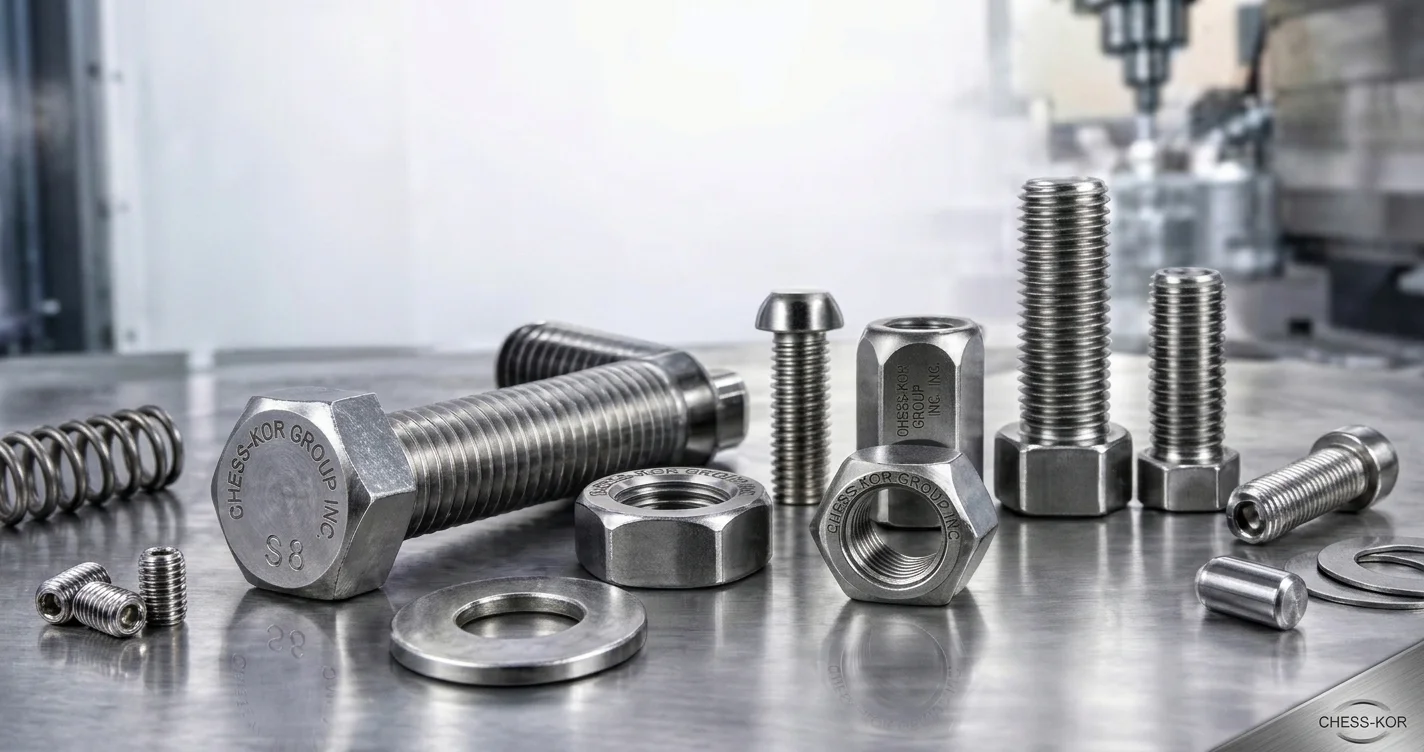
Industrial Fasteners Explained: Types, Grades & Material
This industrial fasteners guide explains the main fastener types, the materials they are made from, what grades like 8.8, 10.9 and 12.9 mean, and which coatings suit which environment. It also gives a simple checklist for specifying fasteners so your supplier can quote the right product the first time.
Fasteners are usually the cheapest items on a job, so people rarely give them much thought. Then a bolt comes loose, a nut rusts through or the wrong grade arrives on site, and suddenly a small part is holding up the whole project.
This industrial fasteners guide covers the basics in plain words, so you know what to look at before you place an order.
What Are Industrial Fasteners and Why Do They Matter?
Industrial fasteners are parts that hold two or more components together. Bolts, nuts, washers, studs and anchors all fall into this group. Unlike welding, most fasteners can be undone, which makes repairs and maintenance much easier.
They matter because every joint depends on them. A bolt with the wrong strength rating can loosen under vibration or snap under load. That is why a proper order always includes size, grade, material and coating, not just a diameter.
What Are the Main Types of Industrial Fasteners?
The main types are bolts, nuts, washers, screws, studs, threaded rods and anchors. Bolts and nuts clamp parts together, washers spread the load, studs and rods handle flanges and supports, and anchors fix equipment to concrete. Each type has a specific job.
Here is how they usually get used.
- Bolts pair with a nut to clamp parts together. Hex bolts and heavy hex bolts are the most common on industrial sites.
- Nuts lock onto bolts, studs or rods. Hex nuts, nyloc nuts and flange nuts cover most needs.
- Washers protect the surface and spread pressure. Flat, spring and lock washers each solve a different problem.
- Screws work well for sheet metal, machine parts and lighter assemblies.
- Studs and threaded rods carry thread along most of their length and show up often in flanges, pipework and pressure equipment.
- Anchor bolts tie steel columns, machines and equipment bases to concrete.
A bolt and its nut must match in thread, pitch and strength class. If one is weaker than the other, the joint is only as strong as the weaker part.
Which Materials Are Used for Industrial Fasteners?
Most industrial fasteners are made from carbon steel, alloy steel or stainless steel. Carbon and alloy steel give strong results at a lower price. Stainless steel resists rust, so it suits wet or chemical areas. Special alloys are kept for extreme heat or harsh chemicals.
| Material | Main Benefit | Typical Use |
| Carbon steel | Good strength, low cost | Structures, machinery, general work |
| Alloy steel | Higher strength and toughness | Heavy equipment, high load joints |
| Stainless steel 304 | General rust resistance | Indoor, food and light outdoor use |
| Stainless steel 316 | Better against salt and chemicals | Marine, coastal and chemical areas |
Many people assume stainless is always the best choice. It is not. It costs more, and some stainless grades are weaker than heat treated alloy steel. Pick the material that fits the actual conditions on your site.
What Do Fastener Grades Mean?
A fastener grade, also called a property class, tells you how strong the fastener is. On metric bolts, a bigger number means higher tensile strength. Grade 8.8 suits general work, 10.9 handles heavier loads, and 12.9 is for very demanding jobs.
| Property Class | Strength Level | Common Use |
| 4.6 | Light duty | Low load fixings |
| 8.8 | Medium to high | Structural and general industrial work |
| 10.9 | High tensile | Machinery and heavy connections |
| 12.9 | Very high tensile | High performance mechanical assemblies |
Two bolts can both be M20 and look exactly the same, yet one is 8.8 and the other 10.9. That is why every industrial fasteners guide tells you to check the grade against your drawing. The official strength requirements are set out in the ISO fastener standards.
Projects that follow American specifications use standards from ASTM International instead. Do not treat a metric grade and an ASTM grade as the same thing. Each standard has its own rules for chemistry, heat treatment and testing.
Which Fastener Coating Should You Choose?
Pick the coating based on where the fastener will be used. Zinc plating gives light protection for dry indoor spots. Hot dip galvanizing adds a much thicker zinc layer for outdoor and structural work. A plain or black finish is used when protection gets added later.
A few things are worth knowing before you decide.
- Zinc plated fasteners carry a thin coating, so they suit indoor or sheltered use.
- Hot dip galvanized fasteners carry a thicker layer and last longer outdoors.
- Galvanizing adds thickness to the thread, so nuts need the right allowance to fit.
- Zinc plating and hot dip galvanizing are two different processes, so never write them as the same thing on an order.
How Do You Specify the Right Fastener?
To specify a fastener properly, give the type, diameter, thread pitch, length, material, grade, coating and the standard it must follow. Add the quantity and delivery location too. Leaving any of these out is the main reason quotes come back wrong or late.
This short checklist from our industrial fasteners guide makes it easy.
- Name the fastener type, such as hex bolt, stud or anchor bolt.
- Give the size, thread pitch and length.
- State the material, for example carbon steel or 316 stainless.
- State the grade, such as 8.8 or 10.9.
- Choose the coating that suits the environment.
- Quote the standard from your drawing, such as ISO, DIN or ASTM.
- Add the quantity and delivery location.
If you are not sure about any of these points, talk to an experienced industrial fasteners supplier before you order. A good supplier will check your details and point out anything that does not suit the application, which can save a lot of money later.
What Mistakes Should You Avoid When Ordering?
The biggest mistakes are ordering by size alone, mixing up coatings and swapping grades without approval. Any one of these can lead to a joint that fails early or a delivery that gets rejected on site.
Watch out for these.
- Ordering “M16 bolts” without a grade, material or standard.
- Using a lower grade nut with a high strength bolt.
- Assuming stainless steel is always the strongest option.
- Replacing a specified fastener with one that only looks similar.
- Quoting from an old drawing revision.
A clear and up to date specification clears up most of these problems before the order is even placed.
Conclusion
Fasteners may be small, but they carry a lot of responsibility in every structure and machine. Type, material, grade and coating all work together, and a gap in any one of them can weaken the whole joint. Keep this industrial fasteners guide close as a checklist the next time you order.
If you want help matching a specification, the team at K Hashim LLC is ready to guide you.
Get the right fasteners quoted the first time
Send us your fastener type, size, grade, material, coating and quantity. Our team will check your specification and come back with a clear quote, so you avoid wrong orders and delays on site.
Explore More Expert Insights
- Circlips vs Snap Rings: What Sets Them Apart: A clear look at how these two retaining fasteners differ in design, fitting method and load handling.
- Internal vs External Circlips: How to Choose the Right One: A simple guide to picking the right circlip based on whether it sits on a shaft or inside a bore.
- 7 Common Mistakes People Make When Buying Butt Welded Fittings: Ordering mistakes to avoid on piping components, many of which also apply to fastener specifications.
- Threaded vs Butt Weld Fittings: Which to Choose in UAE: Helps you decide between threaded and welded connections for pressure, size and maintenance needs.
- Sealing Product Selection Guide: Materials, Types & Applications: A materials and applications guide for choosing sealing products that work alongside bolted joints.
Popular Posts

April 4, 2024

April 22, 2024


May 28, 2024
Stores index
- 01Marine valves19 products
- 02Fittings & flanges10 products
- 03Gaskets & sealing20 products
- 04Fasteners20 products
- 05High-pressure fittings13 products
- 06Epoxies & coatings30 products
- 07Deck & engine store20 products
- 08Safety & PPE12 products
- 09Lifting & rigging7 products
- 10Hoses6 products
- 11Clamps & couplings6 products
- 12Tools & abrasives4 products
- 13Buttweld fittings9 products
- 14Steel flanges8 products
- 15Camlock couplings4 products
- 16Oilfield supplies4 products
- 17Couplings & expansion joints2 products
How an order works
- Send your listItem, size, grade, quantity and delivery location.
- We check stockAvailability is confirmed from our Sharjah warehouse.
- You receive a quotationPriced for your approval, with the delivery terms.
- DeliveryFree on orders of AED 3,000 and above.