
- Buttweld Fittings
- Camlock Couplings and Fittings
- Clamps & Couplings
- Deck & Engine Store Supplies
- Fittings & Flanges
- High-Pressure Pipe Fittings
- Hoses
- Industrial Epoxies & Spray Coatings
- Industrial Fasteners – Bolts, Nuts & Screws
- Industrial Gaskets & Sealing Products
- Lifting & Rigging
- Marine Valves & Flow Control Solutions
- Oilfield, Marine & Industrial Supplies
- Pipe Couplings & Expansion Joints
- Safety Items & Personal Protective Equipment
- Steel Flanges for Piping Systems
- Tools, Abrasives & Drilling
- Industrial Area 1, Sharjah, UAE
- sales@khashim.com
- info@khashim.com
- +971 6 533 8006
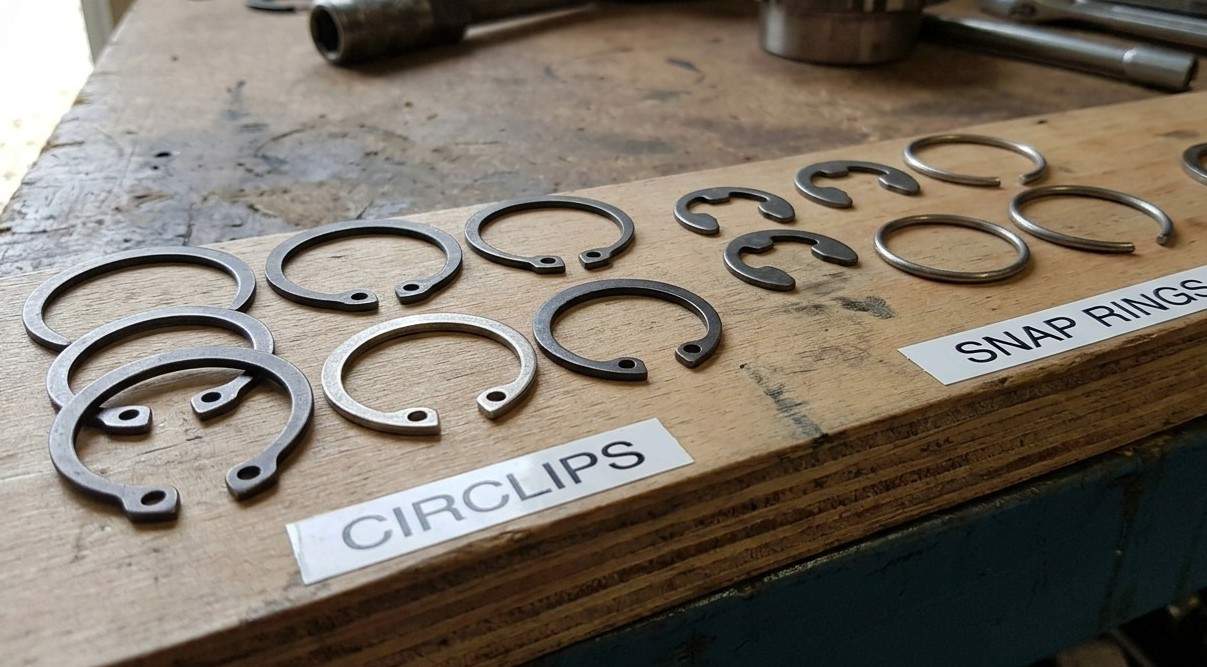
Circlips vs Snap Rings: What Sets Them Apart
While people often use the terms circlip and snap ring interchangeably, they have distinct design features, installation methods, and load capabilities. Both are open-ended spring-steel rings that seat in a groove to hold parts axially, but the ring style, standard, and load rating decide which one fits your design.
A circlip, also known as a C-clip, snap ring, Jesus clip, or retaining ring, is one of the most common fasteners in mechanical assemblies. Engineers comparing circlips vs snap rings often expect two unrelated parts. The confusion costs real time in procurement, where a European drawing calls for a circlip and a North American supplier lists only snap rings.
This guide separates terminology from genuine engineering differences. It also gives you a four-point selection check you can apply to any shaft or bore design.
What Is the Difference Between Circlips vs Snap Rings?
A circlip is also known as a C-clip, snap ring, Jesus clip, or retaining ring, and regional usage explains most of the naming. UK and European drawings say circlip, while North American drawings say snap ring. The real differences lie in ring style, standard, and load capability.
Some engineers reserve circlip for rings with lug holes for pliers, which is habit rather than rule. The nickname Jesus clip comes from the exclamation that follows when a ring slips off the pliers and flies across the workshop.
You may also meet the term Seeger ring. Confirm the part by standard and dimensions, not by name.
Which Standards Define Circlips and Snap Rings?
European circlips follow DIN 471 for external rings and DIN 472 for internal rings, while North American snap rings follow ASME B27.7 and related manufacturer specifications. Groove geometry and tolerances differ between the systems, so the rings are not always interchangeable.
Inch and metric sizing is the first trap. A metric ring may look identical to an inch-series ring yet seat poorly in a groove cut for the other system. Groove width and depth tolerances are tight, and a few hundredths of a millimetre can change thrust capacity.
Treat the standard as the part definition. Specify it on the drawing alongside material and finish.
What Are the Main Types of Retaining Rings?
Retaining rings fall into three practical groups: external snap rings for shafts, internal snap rings for bores, and radial-install rings such as E-clips. External and internal snap rings install axially with pliers, while E-clips press on from the side, which suits tight spaces.
- External snap rings (DIN 471): seat in a shaft groove and locate bearings or hubs.
- Internal snap rings (DIN 472): seat in a bore groove and retain gears, bearings, or pistons.
- E-clips (DIN 6799): install radially on light-duty shafts without access to the shaft end.
- Beveled rings: have a tapered section that presses the retained part against the shoulder and removes end play.
How Do You Choose Between Circlips vs Snap Rings?
Select a ring by checking four factors in order: axial load, installation access, rotational speed, and operating environment. Calculate thrust against the groove wall rather than the ring alone, because in many designs the groove yields before the ring does, especially in softer shaft materials.
- Axial load: Compare the ring’s rated thrust with the groove wall’s shear capacity, and apply a safety factor.
- Access: Confirm that pliers or assembly tooling can reach the ring in the finished assembly.
- Speed: At high rpm, centrifugal force can lift external snap rings out of the groove, so use rings rated for the speed.
- Environment: Match material and finish to corrosion, temperature, and chemical exposure.
Stainless grades resist corrosion but can carry lower rated loads than carbon spring steel. Verify the catalog values rather than assuming equivalence.
If your team is reconciling DIN and ASME drawings, request a groove-tolerance review before releasing the bill of materials. It catches most sourcing mismatches early.
Why Do Retaining Rings Fail?
Retaining rings usually fail through groove-wall yielding, ring rotation, or spin-off at speed rather than through ring fracture. Poor groove machining, reused rings that have lost spring tension, and thrust faces loaded beyond rated capacity are the most common contributing causes.
Rings should seat against a sharp-cornered component. A large chamfer or radius on the retained part lets the ring tilt, or dish, under load. Use a beveled ring when end play must be eliminated.
Final Recommendation
Circlips vs snap rings is a naming question first and an engineering question second. Confirm the standard, groove geometry, material, and load on the drawing. Then validate speed and installation access before you release the order.
If you need help sourcing the right retaining rings, K Hashim LLC is a circlips supplier in Dubai, UAE, that can support you with specification and supply.
Drawing Says Circlip, Supplier Says Snap Ring?
Send us your drawing and we will match it to the correct DIN or ASME standard. We also review groove tolerances so the ring you order is the ring that fits.
Request a Standard CheckFAQ
Are circlips and snap rings interchangeable?
Often, but not always. Rings with the same nominal size can differ in thickness, groove width, and tolerance between DIN and ASME systems. Verify the standard and groove dimensions before substituting.
What is the difference between a circlip and an E-clip?
A standard internal or external circlip installs axially over the shaft end or into a bore, while an E-clip presses on from the side into a shaft groove. E-clips assemble faster but carry lower thrust loads.
Can you reuse a circlip or snap ring?
Avoid reuse in critical assemblies. Removal can stretch the ring and reduce spring tension, which weakens its grip in the groove. Replace rings after every disassembly on safety-critical or high-speed equipment.
Explore More Expert Insights
Explore our expert insights to learn more about buttweld fittings, their types, standards and practical applications.
- Pipe Fittings Selection Guide: Types, Features, and Applications: A wider look at choosing the right fitting across residential, commercial and industrial piping.
- Choosing Steel Flanges for Industrial Piping in Dubai: Key factors for selecting the right flange to pair with your buttweld fittings.
- Differences Between Gate Valves and Globe Valves: A comparison to help you choose the right valve for flow control alongside your piping.
- Importance of Expansion Joints in Building Construction: Why expansion joints matter for pipeline and structural durability.
- 5 Signs Your Industrial Hose Needs Replacement: Key signs that your industrial hose needs replacing before failure occurs.
Popular Posts

April 4, 2024

April 22, 2024


May 28, 2024
Stores index
- 01Marine valves19 products
- 02Fittings & flanges10 products
- 03Gaskets & sealing20 products
- 04Fasteners20 products
- 05High-pressure fittings13 products
- 06Epoxies & coatings30 products
- 07Deck & engine store20 products
- 08Safety & PPE12 products
- 09Lifting & rigging7 products
- 10Hoses6 products
- 11Clamps & couplings6 products
- 12Tools & abrasives4 products
- 13Buttweld fittings9 products
- 14Steel flanges8 products
- 15Camlock couplings4 products
- 16Oilfield supplies4 products
- 17Couplings & expansion joints2 products
How an order works
- Send your listItem, size, grade, quantity and delivery location.
- We check stockAvailability is confirmed from our Sharjah warehouse.
- You receive a quotationPriced for your approval, with the delivery terms.
- DeliveryFree on orders of AED 3,000 and above.