
- Abrasives & Drilling
- Buttweld Fittings
- Camlock Couplings and Fittings
- Clamps & Couplings
- Deck & Engine Store Supplies
- Fasteners & Hardware
- Fittings & Flanges
- Gaskets
- High-Pressure Pipe Fittings
- Hoses
- Industrial Epoxies & Spray Coatings
- Industrial Fasteners – Bolts, Nuts & Screws
- Industrial Gaskets & Sealing Products
- Lifting & Rigging
- Marine
- Marine Valves & Flow Control Solutions
- Oilfield & Industrial Supplies
- Packing & Industrial Materials
- Pipe Couplings & Expansion Joints
- PPE & Chemicals
- Safety
- Safety Items & Personal Protective Equipment
- Steel Flanges for Piping Systems
- Tools
- Valves
- Industrial Area 1, Sharjah, UAE
- sales@khashim.com
- info@khashim.com
- +971 6 533 8006
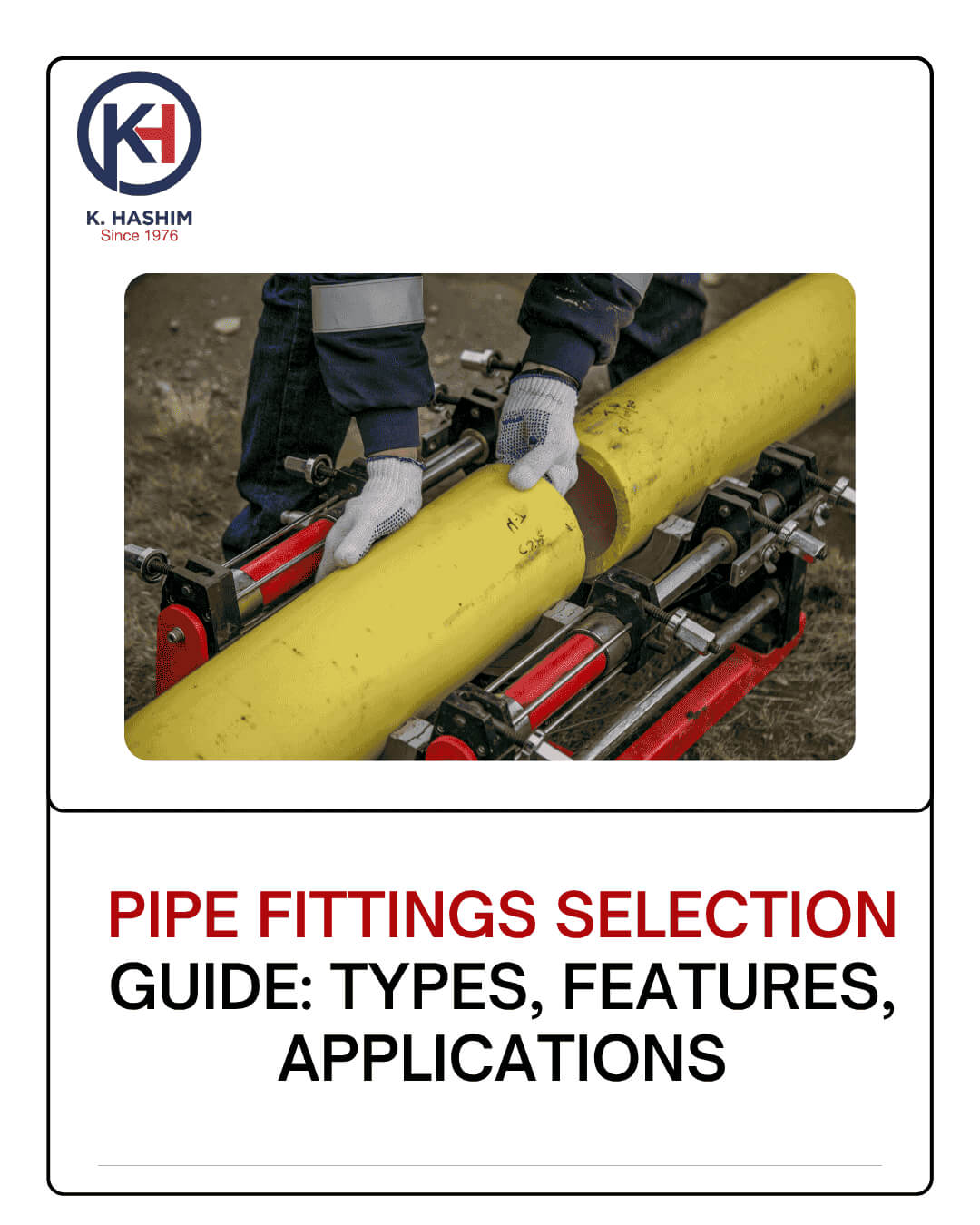
Pipe Fittings Selection Guide: Types, Features, and Applications
Selecting the right pipe fittings is one of the most important decisions in plumbing, industrial piping, and construction systems. The performance, safety, and efficiency of any piping network depend heavily on the quality and compatibility of its fittings. Whether it’s for water distribution, gas lines, HVAC systems, or industrial fluid transport, understanding how to make the right pipe fittings selection can prevent leaks, corrosion, and long-term maintenance issues.
In this guide, we’ll explore the most common types of pipe fittings, their features, materials, and practical applications across residential, commercial, and industrial sectors.
Understanding the Importance of Pipe Fittings Selection
Every piping system needs secure connections to ensure smooth fluid flow and structural integrity. Proper pipe fittings selection ensures the right size, material, pressure rating, and joint type for the system. Engineers and contractors must also consider the medium being transported, whether water, gas, oil, or chemicals, to choose compatible materials like stainless steel, brass, PVC, or copper.
A well-planned pipe fittings selection process guarantees longevity, leak resistance, and energy efficiency. It also reduces downtime in maintenance and enhances overall system performance.
Types of Pipe Fittings and Their Applications
Pipe fittings come in a wide variety of shapes and functions, each designed for specific tasks such as changing direction, connecting pipes, or closing ends. Below are some of the most commonly used fittings and their roles in plumbing and industrial applications.
1. Threaded Connectors: The Role of the Barrel Nipple
A Barrel Nipple is a short piece of pipe with external threads on both ends, used to connect two female-threaded fittings or valves. It’s commonly found in plumbing systems, oil and gas pipelines, and compressed air setups. When you focus on pipe fittings selection, consider the thread type (BSP or NPT) and the pressure rating to ensure compatibility with your system.
Barrel nipples are available in stainless steel, carbon steel, and brass, providing excellent resistance to corrosion and temperature variations.
2. End Closures and Safety: Using a Cap
A cap fitting is used to seal the end of a pipe. It’s essential in situations where a pipe system may be extended later or temporarily closed during testing. During the pipe fittings selection process, caps are chosen based on size, material, and whether the system will experience internal pressure.
Stainless steel and PVC caps are ideal for plumbing and water lines, while threaded carbon steel caps are used in high-pressure industrial environments.
3. Joining Pipes Efficiently: The Function of a Coupling
A coupling connects two pipes of the same diameter, maintaining the system’s flow and structural strength. There are full couplings, half couplings, and reducing couplings, each serving different purposes depending on system requirements.
When doing a pipe fittings selection, a coupling is chosen based on the joining method, threaded, welded, or compression type, and its resistance to pressure and corrosion. Couplings are commonly used in water distribution, irrigation systems, and chemical pipelines.
4. Four-Way Flow Control: The Cross Fitting
A cross fitting, also called a four-way fitting, has four openings arranged at right angles to each other. It allows fluid to split into different directions or merge multiple flows. Proper pipe fittings selection here involves considering equal or unequal outlet sizes, depending on whether the system requires balanced or reduced flow rates.
Cross fittings are widely used in fire sprinkler systems, industrial manifolds, and HVAC systems where multiple pipelines converge.
5. Adapting Sizes: The Importance of a Hex Bushing
A hex bushing is a small but vital fitting used to connect pipes of different sizes. Its hexagonal shape makes installation easy using a wrench, ensuring a tight, leak-proof connection. During pipe fittings selection, bushings are chosen based on thread compatibility and system pressure requirements.
They are typically used in compressed air lines, water supply systems, and hydraulic installations to ensure proper flow transition between large and small pipes.
6. Reliable Connections: How a Hex Nipple Works
A hex nipple has male threads on both ends and a hexagonal center for tightening. It is used to connect two female-threaded fittings, much like a barrel nipple, but allows for easier wrench handling. During pipe fittings selection, a hex nipple is preferred for systems requiring durable metal-to-metal sealing.
These fittings are ideal for applications in oil refineries, water treatment facilities, and heavy-duty construction pipelines.
7. Sealing the System: The Plug
A plug is a small but essential fitting used to close off the end of a pipe or an unused outlet in a fitting. It can be threaded or welded depending on the piping system. A proper pipe fittings selection ensures the plug material matches the rest of the system to prevent galvanic corrosion.
Plugs are commonly used during testing phases or in systems that may require future expansion.
8. Flow Diversion and Branching: The Tee Fitting
A tee fitting has three openings, one inlet and two outlets, used to combine or split fluid flow. Available in equal and reducing variants, tees are crucial for building branch lines in plumbing and industrial systems.
When considering pipe fittings selection, tees are evaluated for their compatibility with system pressure and medium type. They are frequently used in water distribution, gas pipelines, and chemical plants.
9. Easy Maintenance and Disassembly: The Union
A union fitting allows two pipes to be easily joined and disconnected without cutting the pipe. It is perfect for systems that require frequent maintenance, inspection, or cleaning. During pipe fittings selection, a union fitting is chosen for convenience, durability, and leak resistance.
Unions are widely used in HVAC units, water heaters, and high-pressure hydraulic systems, making them one of the most versatile fittings available.
Key Considerations for Pipe Fittings Selection
When choosing the right fittings for any system, keep these essential factors in mind:
- Material Compatibility: Select fittings that match the pipe material to prevent corrosion or galvanic reactions.
- Pressure and Temperature Ratings: Ensure the fitting can withstand the operational limits of your system.
- Connection Type: Decide between threaded, welded, or flanged connections depending on the application.
- Size and Dimension: Always measure accurately to ensure tight and leak-proof fits.
- Standards Compliance: Opt for fittings that comply with ISO, ASTM, or ASME standards for safety and reliability.
Proper pipe fittings selection based on these factors guarantees system integrity and operational safety.
Applications of Pipe Fittings Across Industries
Pipe fittings are used in almost every industry, from plumbing to petrochemical plants. Common applications include:
- Residential Plumbing: For water supply and drainage systems.
- Oil and Gas: High-pressure pipelines require durable steel fittings.
- HVAC Systems: For regulating airflow and refrigerant circulation.
- Chemical Processing: Corrosion-resistant materials like stainless steel and PVC are preferred.
- Agricultural Irrigation: Lightweight couplings and tees help maintain efficient water flow.
A smart pipe fittings selection approach ensures that each fitting performs reliably within its intended application.
FAQs
1. What are the different types of pipe fittings?
The main types of pipe fittings include elbows, tees, couplings, unions, reducers, caps, plugs, crosses, and nipples. Each type serves a specific function such as changing direction, connecting pipes, or sealing ends.
2. What are the applications of pipe fittings?
Pipe fittings are used in plumbing, oil and gas pipelines, chemical processing, HVAC systems, water treatment plants, and industrial fluid transfer to connect, control, or direct flow within piping networks.
3. How to choose pipe fittings?
Choose pipe fittings based on pipe material, size, pressure rating, temperature range, and media type. Also, consider corrosion resistance and compatibility with the pipe schedule (e.g., 10, 40, or 80).
4. What are the 5 examples of fittings?
Five common examples of pipe fittings are: elbow, tee, coupling, union, and plug, each designed to change direction, join sections, or close pipe ends effectively.
Conclusion
Selecting the right pipe fittings is essential for achieving long-lasting and efficient piping systems. From simple connectors like barrel nipples and couplings to specialized fittings like crosses, tees, and unions, each component plays a crucial role in performance and safety.
A well-informed pipe fittings selection ensures optimal flow, pressure management, and ease of maintenance, whether in a residential setup or a complex industrial network. By focusing on compatibility, durability, and design, you can create piping systems that stand the test of time and deliver superior functionality.
Contact us on +971 50 486 7361 for purchasing high-quality tools, a renowned provider of quality products spanning the Marine, Oilfield, and Industrial Supply sectors. With over 45 years of experience.
Explore More Expert Insights
Discover deck & engine components, marine epoxies, fasteners, fittings, flanges, valves, and gauges for your next project.
–Tips On Using Fasteners For High-Temperature Applications – Guide to Using Fasteners Safely in High-Temperature Settings
–Guide to Choosing Steel Flanges for Industrial Piping in Dubai – Selecting the Right Steel Flanges for Industrial Piping
–Unlocking Potential of SS Grease Nipples in UAE Industries – Maximize Efficiency with Stainless Steel Grease Nipples
–Choosing the Right Sounding Cock Test Valve Supplier in UAE – Find Trusted Sounding Cock Test Valve Suppliers in UAE
–PPE Kit Guide: Safety Equipment Standards & Requirements – Comprehensive PPE Kit Guide for Safety Compliance in UAE
Popular Posts

April 4, 2024

April 22, 2024


May 28, 2024