
- Abrasives & Drilling
- Buttweld Fittings
- Camlock Couplings and Fittings
- Clamps & Couplings
- Deck & Engine Store Supplies
- Fasteners & Hardware
- Fittings & Flanges
- Gaskets
- High-Pressure Pipe Fittings
- Hoses
- Industrial Epoxies & Spray Coatings
- Industrial Fasteners – Bolts, Nuts & Screws
- Industrial Gaskets & Sealing Products
- Lifting & Rigging
- Marine
- Marine Valves & Flow Control Solutions
- Oilfield & Industrial Supplies
- Packing & Industrial Materials
- Pipe Couplings & Expansion Joints
- PPE & Chemicals
- Safety
- Safety Items & Personal Protective Equipment
- Steel Flanges for Piping Systems
- Tools
- Valves
- Industrial Area 1, Sharjah, UAE
- sales@khashim.com
- info@khashim.com
- +971 6 533 8006
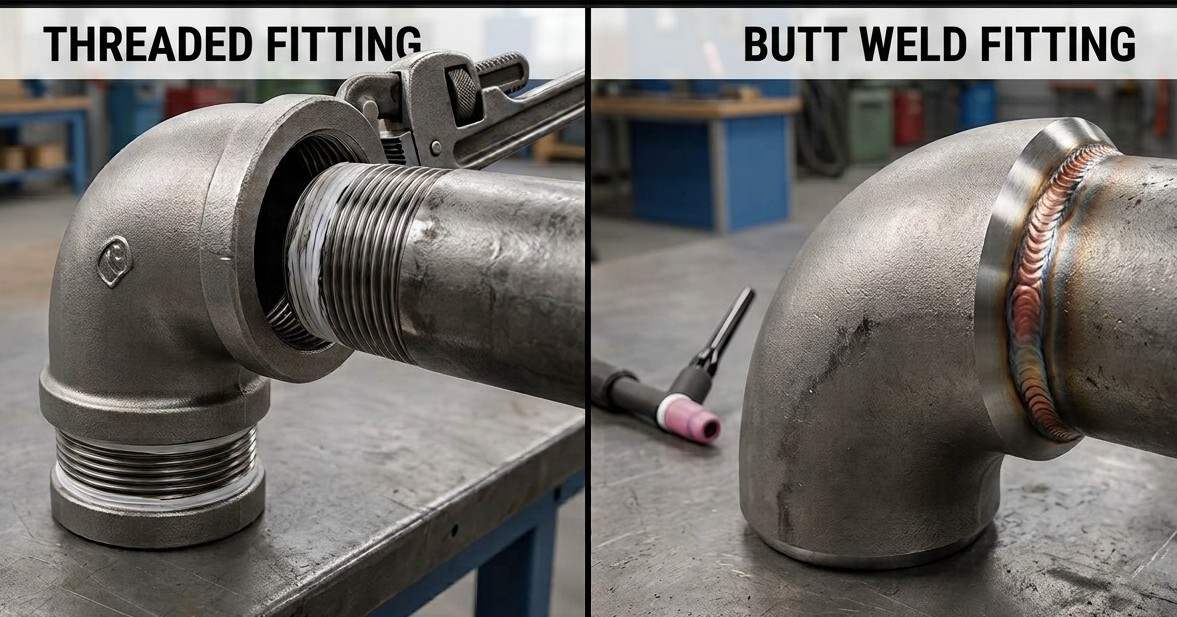
Threaded vs Butt Weld Fittings: Which to Choose in UAE
Use threaded fittings for low-pressure, non-critical, smaller-scale lines (NPS 2 and below) that need frequent maintenance, such as water distribution or air lines. Use butt weld fittings for critical, high-pressure, high-temperature service in oil and gas, petrochemical plants, refineries, and power generation.
Choosing between threaded vs butt weld fittings looks like a routine procurement decision. It is not. The wrong joint type causes leaks, rework, and failed inspections, especially in UAE plants where heat, humidity, and saline air punish weak connections.
This guide gives engineers and procurement leads a practical framework for matching each joint to its service, using ASME standards and field conditions common across the Emirates.
What Separates Threaded vs Butt Weld Fittings?
Threaded fittings join pipe through tapered screw threads, while butt weld fittings join pipe through a full-penetration weld at beveled ends. The threaded joints install quickly without welding labor, and butt weld joints create a continuous metal path for critical service.
Threaded fittings follow ASME B16.11 and use NPT threads defined in ASME B1.20.1. Butt weld fittings follow ASME B16.9 and are installed under ASME B31.3 process piping rules.
When Should You Use Threaded Fittings?
Threaded fittings are best for low-pressure, non-critical, and smaller-scale systems requiring frequent maintenance or modifications, such as water distribution or air lines. They typically serve NPS 2 and below, and suit areas where hot work is restricted or welding is impractical.
Three limits matter in practice:
- Thread sealant degrades under thermal cycling and vibration.
- Cut threads thin the pipe wall, so Schedule 80 or heavier is standard practice.
- Thread roots trap moisture, which accelerates crevice corrosion in coastal environments.
Avoid threaded joints on cyclic, vibrating, or toxic lines. Every thread is a potential leak path and a stress concentration point.
Unsure which joint your piping class allows? Request a fittings specification review before you finalize the material take-off.
Why Are Butt Weld Fittings Essential for Critical Service?
Butt weld fittings are essential for critical, high-pressure, and high-temperature industries like oil and gas, petrochemical plants, refineries, and power generation. The full-penetration weld removes the leak path and allows radiographic or ultrasonic examination of every joint.
Demand for butt weld fittings in UAE projects follows the region’s industrial base. Process headers in upstream facilities, refineries, and desalination plants rely on welded joints because operators cannot tolerate leaks in hydrocarbon or steam service.
Butt weld work demands qualified welders, approved welding procedure specifications, and post-weld inspection. Those requirements add schedule and labor cost. Over a 25-year asset life, however, fewer leak events usually outweigh the upfront expense.
How Do Threaded vs Butt Weld Fittings Compare on Cost and Risk?
Threaded fittings cost less to install and allow quick disassembly, but they carry lower practical pressure ratings and higher leak risk. Butt weld fittings cost more to install and cannot be dismantled without cutting, yet they deliver the strongest joint and the lowest lifecycle leak rate.
- Pressure: Threaded fittings reach Class 6000 under B16.11, but field limits sit lower. Butt weld fittings match the pipe schedule rating.
- Inspection: Threaded joints cannot be radiographed. Butt welds accept RT and UT.
- Flow: Butt welds keep a smooth bore, while threads create turbulence and erosion points.
- Maintenance: Threaded joints unscrew. Welded joints require cutting and rewelding.
- Upfront cost: Threaded joints win on small sizes.
What Framework Should You Use to Select the Right Fitting?
Score four factors before selecting: fluid hazard, pressure and temperature, line size, and maintenance access. If fluid hazard or pressure is high, choose butt weld. If the line is small, low-risk, and needs frequent removal, choose threaded.
Run this checklist for each line class:
- Classify the fluid under ASME B31.3 as Normal, Category D, or Category M.
- Compare design pressure and temperature against the piping class rating.
- Restrict threaded joints to NPS 2 and below.
- Confirm material and corrosion allowance for saline or high-humidity exposure.
- Verify welder qualification and inspection capacity before committing to welded joints.
- Record the decision in the piping class so contractors cannot substitute joints on site.
Audit field substitutions during construction. Contractors often swap joint types to save time, and those changes rarely pass back through design review.
Conclusion
The threaded vs butt weld fittings decision comes down to hazard, pressure, size, and access. Use threaded joints sparingly on small, low-risk lines and default to butt weld for anything critical. K Hashim LLC helps UAE project teams match fittings to piping classes and avoid costly specification errors. Schedule a consultation with our team before your next material take-off.
Choose the right fittings the first time
Tell us your pipe size, material grade, pressure class, and service conditions. Our team will recommend suitable threaded or butt weld fittings with the documents your inspector expects. You get clear guidance and a prompt quote for your project.
Request a Fittings QuoteFrequently Asked Questions
Can threaded fittings handle high-pressure service?
Threaded fittings can carry high pressure on paper, since ASME B16.11 covers Class 6000 ratings for small sizes. In practice, vibration, thermal cycling, and thread leakage make them unsuitable for most high-pressure hydrocarbon lines and any toxic or flammable service.
Which joint resists UAE coastal corrosion better?
Butt weld joints resist coastal corrosion better because they have no thread roots to trap moisture and salt. Material choice still decides final performance in chloride-rich service, so specify 316L, duplex stainless, or coated carbon steel to match the environment.
Which standards govern these fittings?
ASME B16.11 governs forged threaded and socket weld fittings, and ASME B16.9 governs factory-made wrought butt weld fittings. ASME B31.3 sets the process piping design, welding, and inspection rules that determine which joint types your project may use.
Explore More Expert Insights
Explore our expert insights to learn more about buttweld fittings, their types, standards and practical applications.
- Pipe Fittings Selection Guide: Types, Features, and Applications: A wider look at choosing the right fitting across residential, commercial and industrial piping.
- Choosing Steel Flanges for Industrial Piping in Dubai: Key factors for selecting the right flange to pair with your buttweld fittings.
- Differences Between Gate Valves and Globe Valves: A comparison to help you choose the right valve for flow control alongside your piping.
- Importance of Expansion Joints in Building Construction: Why expansion joints matter for pipeline and structural durability.
- 5 Signs Your Industrial Hose Needs Replacement: Key signs that your industrial hose needs replacing before failure occurs.
Popular Posts

April 4, 2024

April 22, 2024


May 28, 2024