
- Buttweld Fittings
- Camlock Couplings and Fittings
- Clamps & Couplings
- Deck & Engine Store Supplies
- Fittings & Flanges
- High-Pressure Pipe Fittings
- Hoses
- Industrial Epoxies & Spray Coatings
- Industrial Fasteners – Bolts, Nuts & Screws
- Industrial Gaskets & Sealing Products
- Lifting & Rigging
- Marine Valves & Flow Control Solutions
- Oilfield, Marine & Industrial Supplies
- Pipe Couplings & Expansion Joints
- Safety Items & Personal Protective Equipment
- Steel Flanges for Piping Systems
- Tools, Abrasives & Drilling
- Industrial Area 1, Sharjah, UAE
- sales@khashim.com
- info@khashim.com
- +971 6 533 8006
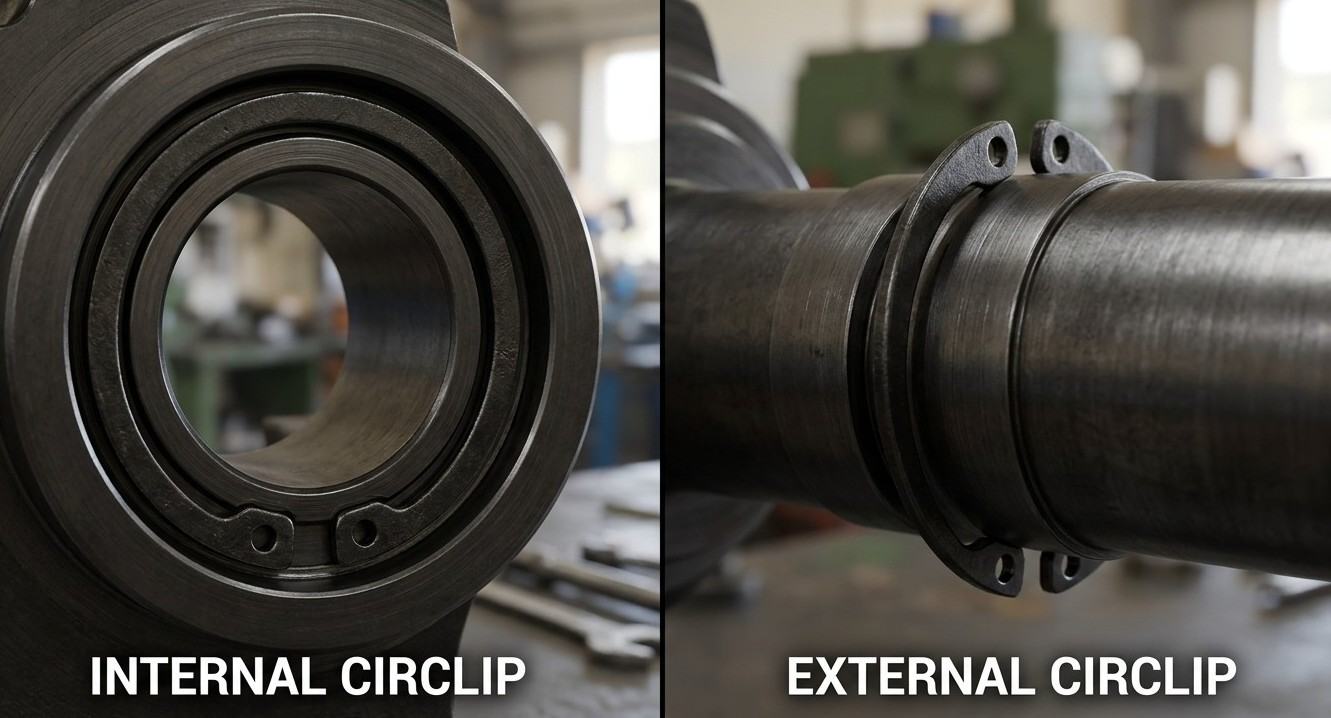
Internal vs External Circlips: How to Choose the Right One
Use external circlips when the ring sits in a groove on a shaft, and internal circlips when it sits in a groove inside a bore. The mounting location decides the type. Load, speed, and assembly space then determine the series and size.
Choosing between internal vs external circlips looks simple on a drawing. In production, the wrong choice causes axial play, ring spin-off, and groove damage. This guide covers how each type works, where each one fails, and how to select one with confidence.
What Is a Circlip?
A circlip (also known as a retaining ring, snap ring, or C-clip) is a semi-flexible metal ring with open ends that snaps into a machined groove on a shaft or inside a bore. It acts as a removable shoulder that holds parts in position along an axis.
A circlip snap ring replaces heavier fastening methods such as nuts, pins, or machined shoulders. It saves space and weight, and it is quick to fit and remove during maintenance.
What Is the Difference Between Internal and External Circlips?
Internal circlips fit into a groove machined inside a housing bore, and they hold components such as bearings in place. External circlips fit into a groove cut on the outside of a shaft. The difference is where the ring seats and which way it flexes.
An internal circlip is compressed before insertion. It springs outward into the bore groove and presses against the groove wall.
An external circlip is expanded over the shaft end. It then springs inward and grips the groove base.
Both types are standardized. DIN 472 covers internal rings for bores, and DIN 471 covers external rings for shafts. Ordering to these standards keeps groove dimensions and ring thickness consistent across suppliers.
When Should You Use External Circlips?
Use external circlips to locate bearings, gears, pulleys, or sleeves along a shaft. They suit designs where the shaft end is accessible and the component can be pushed over it. They are also the common choice for retaining a bearing inner race.
External circlips are easy to fit with standard pliers. Their weak point is rotational speed. At high rpm, centrifugal force pushes the ring outward and can lift it off the groove base.
Check these points before selecting an external ring:
- Shaft diameter and groove diameter tolerance
- Maximum operating speed against the ring’s rated limit
- Thrust load acting on the groove wall
- Edge radius on the component pressing against the ring
When Should You Use Internal Circlips?
Use internal circlips when a component must be held inside a housing, such as a bearing outer race, a piston pin, or a seal carrier. They suit compact assemblies where nothing protrudes beyond the housing face. The ring stays contained, which also protects it from external damage.
Internal circlips handle speed better in most cases. Centrifugal force drives the ring into the groove rather than out of it. That makes them a safer fit for rotating housings.
Installation is the trade-off. The ring must be compressed inside a bore, so access and tool clearance matter. Poor seating is the most common field failure.
How Do Internal vs External Circlips Compare?
The two types differ in seating direction, speed behavior, and installation method. External rings expand over a shaft and can lift at high speed. Internal rings compress into a bore and seat more securely under rotation. Thrust capacity depends mostly on the groove, not the ring.
| Factor | Internal Circlip | External Circlip |
| Mounting location | Bore groove | Shaft groove |
| Installation | Compressed | Expanded |
| High-speed behavior | Seats into groove | May lift off groove |
| Standard | DIN 472 | DIN 471 |
| Typical use | Bearing outer race | Bearing inner race |
Use this table as a first filter. Then confirm the details against load and speed data.
What Causes Circlip Failure?
Most circlip failures come from the groove, not the ring. A groove that is too shallow, too wide, or poorly finished cannot carry the thrust load. The ring then deforms, shears, or jumps out of position.
These are the common failure vectors:
- Groove wall shear under axial load
- Ring spin-off at excessive speed
- Rounded or oversized corner radius on the mating part, which pushes the ring out
- Fatigue from vibration and repeated load cycles
- Reused rings that have lost spring tension
Treat the ring and groove as one system. Specify the groove material, hardness, and surface finish with the same care as the ring.
Material quality matters as well. Rings made from inconsistent spring steel lose tension early. Buying from a dependable circlips supplier in Dubai, UAE, who provides certified material and standard-compliant dimensions, reduces this risk.
What Is a Simple Selection Checklist?
Work through five checks in order: mounting location, load direction, speed, access, and tolerance. If a design passes all five, the ring type and size are almost always correct. This takes minutes and prevents costly rework.
- Location: Shaft means external. Bore means internal.
- Load: Confirm thrust load is below the groove wall capacity.
- Speed: Compare operating rpm to the ring’s limit.
- Access: Make sure plier tips can reach the lugs.
- Tolerance: Verify groove diameter and width against the standard.
Run this checklist during design review, not at assembly. A groove error found on the shop floor costs far more than one caught on paper.
Final Recommendation
Internal vs external circlips is a question of location first and operating conditions second. Pick the type that matches the groove, then validate load, speed, and installation access. Order every circlip snap ring to DIN 471 or DIN 472 and inspect every groove.
If you need help sourcing the right retaining rings, K Hashim LLC is a circlips supplier in Dubai, UAE, that can support you with specification and supply.
Choose the right circlips the first time
Tell us your shaft or bore size, material grade, load, and operating speed. Our team will recommend suitable internal or external circlips with the documents your inspector expects. You get clear guidance and a prompt quote for your project.
Request a Circlips QuoteFAQ
What is the main difference between internal and external circlips?
Internal circlips fit into a groove inside a bore and are compressed during installation. External circlips fit into a groove on a shaft and are expanded during installation. The mounting location decides which type you need.
Can you use an external circlip in a bore?
No. An external circlip is designed to grip a shaft groove and spring inward. Placing it in a bore groove would prevent proper seating and fail to hold the component.
Which circlip is better for high-speed applications?
Internal circlips usually perform better at high speed because centrifugal force pushes them into the groove. External circlips can lift off the groove base at high rpm, so check the manufacturer’s speed rating.
Explore More Expert Insights
Explore our expert insights to learn more about buttweld fittings, their types, standards and practical applications.
- Pipe Fittings Selection Guide: Types, Features, and Applications: A wider look at choosing the right fitting across residential, commercial and industrial piping.
- Choosing Steel Flanges for Industrial Piping in Dubai: Key factors for selecting the right flange to pair with your buttweld fittings.
- Differences Between Gate Valves and Globe Valves: A comparison to help you choose the right valve for flow control alongside your piping.
- Importance of Expansion Joints in Building Construction: Why expansion joints matter for pipeline and structural durability.
- 5 Signs Your Industrial Hose Needs Replacement: Key signs that your industrial hose needs replacing before failure occurs.
Popular Posts

April 4, 2024

April 22, 2024


May 28, 2024
Stores index
- 01Marine valves19 products
- 02Fittings & flanges10 products
- 03Gaskets & sealing20 products
- 04Fasteners21 products
- 05High-pressure fittings13 products
- 06Epoxies & coatings19 products
- 07Deck & engine store20 products
- 08Safety & PPE12 products
- 09Lifting & rigging7 products
- 10Hoses6 products
- 11Clamps & couplings6 products
- 12Tools & abrasives4 products
- 13Buttweld fittings9 products
- 14Steel flanges8 products
- 15Camlock couplings4 products
- 16Oilfield supplies10 products
- 17Couplings & expansion joints2 products
How an order works
- Send your listItem, size, grade, quantity and delivery location.
- We check stockAvailability is confirmed from our Sharjah warehouse.
- You receive a quotationPriced for your approval, with the delivery terms.
- DeliveryFree on orders of AED 3,000 and above.