
- Buttweld Fittings
- Camlock Couplings and Fittings
- Clamps & Couplings
- Deck & Engine Store Supplies
- Fittings & Flanges
- High-Pressure Pipe Fittings
- Hoses
- Industrial Epoxies & Spray Coatings
- Industrial Fasteners – Bolts, Nuts & Screws
- Industrial Gaskets & Sealing Products
- Lifting & Rigging
- Marine Valves & Flow Control Solutions
- Oilfield, Marine & Industrial Supplies
- Pipe Couplings & Expansion Joints
- Safety Items & Personal Protective Equipment
- Steel Flanges for Piping Systems
- Tools, Abrasives & Drilling
- Industrial Area 1, Sharjah, UAE
- sales@khashim.com
- info@khashim.com
- +971 6 533 8006
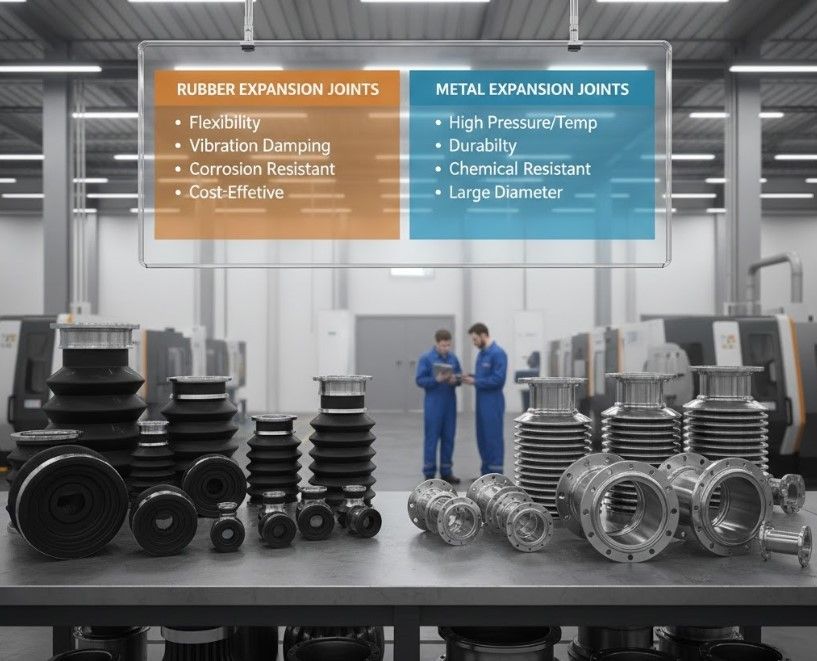
Which Expansion Joint Is Better: Rubber or Metal?
When it comes to designing piping systems for industrial, commercial, or residential projects, expansion joints play a crucial role. They absorb thermal expansion, reduce vibration, and protect piping integrity.
Choosing between rubber and metal expansion joints can be challenging for engineers, procurement managers, and facility owners. This guide breaks down the differences, benefits, and selection criteria to help you make an informed choice.
What Are Expansion Joints?
Expansion joints are flexible connectors installed between sections of pipes, ducts, or equipment to absorb movement caused by thermal changes, pressure variations, or mechanical forces. They prevent damage such as cracking, leakage, or fatigue in systems that experience regular expansion and contraction.
Types of Expansion Joints
- Rubber Expansion Joints: Made from elastomeric materials with fabric reinforcement
- Metal Expansion Joints: Fabricated from stainless steel, carbon steel, or alloy steel
These joints are widely used across industries including HVAC, chemical processing, water treatment, oil and gas, and power generation.
Rubber Expansion Joints
Rubber expansion joints are flexible connectors made from elastomeric materials such as EPDM, Neoprene, or Nitrile. They often feature fabric reinforcement to handle pressure and are widely used in water, chemical, and HVAC systems.
Features and Benefits
Flexibility
Rubber joints provide high elasticity, accommodating axial, lateral, and angular movement in piping systems.
Vibration and Noise Reduction
They absorb vibrations and reduce operational noise, making them ideal for HVAC and water pipelines.
Corrosion Resistance
Resistant to mild chemicals and water, rubber joints prevent early degradation in low to medium pressure applications.
Lightweight and Easy Installation
Rubber expansion joints are easy to handle and install, even in confined spaces, reducing labor and installation time.
Ideal Applications
- Steam lines in power plants
- High-pressure chemical processing
- Petrochemical and refinery piping
- High-temperature exhaust systems
Popular Brands and Suppliers
- Belman
- James Walker
- KSB
Evaluation Criteria for Metal Joints
- Pressure and temperature rating
- Movement absorption capability
- Material grade and corrosion resistance
- Compliance with standards such as ASME or EN
- Warranty, service, and technical support
Metal Expansion Joints
Metal expansion joints, often made from stainless steel, carbon steel, or alloyed metals, use bellows to absorb movement. They are engineered for high-temperature and high-pressure applications.
Features and Benefits
Metal expansion joints are preferred for high-pressure, high-temperature, and corrosive environments. Key features include:
High-Pressure Tolerance
Metal joints withstand high pressure, making them suitable for steam, gas, and chemical applications.
Temperature Resistance
They maintain integrity at extreme temperatures, often up to 600°C, ensuring long-term performance.
Durability and Longevity
Metal expansion joints are strong and long-lasting, performing reliably in harsh industrial environments.
Customizable Design
These joints can be tailored for complex piping layouts, handling multiple movement types efficiently.
Ideal Applications
- Steam lines in power plants
- High-pressure chemical processing
- Petrochemical and refinery piping
- High-temperature exhaust systems
Popular Brands and Suppliers
- Belman
- James Walker
- KSB
Evaluation Criteria for Metal Joints
- Pressure and temperature rating
- Movement absorption capability
- Material grade and corrosion resistance
- Compliance with standards such as ASME or EN
- Warranty, service, and technical support
Rubber vs Metal Expansion Joints Comparison
| Feature | Rubber Expansion Joints | Metal Expansion Joints |
|---|---|---|
| Flexibility | High | Moderate |
| Vibration & Noise | Excellent | Moderate |
| Temperature Range | Up to 100°C | Up to 600°C |
| Pressure Rating | Low to Medium | High |
| Chemical Resistance | Good for mild chemicals | Excellent for harsh chemicals |
| Installation | Easy, lightweight | Heavy, requires precise alignment |
| Maintenance | Low | Moderate to high |
| Cost | Affordable | Higher upfront cost |
This table provides a quick reference for buyers to evaluate which type suits their project requirements.
How to Choose the Right Expansion Joint
Selecting the right expansion joint is critical for system reliability, safety, and long-term performance. Understanding the importance of expansion joints can help you determine where different types of joints are essential, while several key factors should guide your decision.
System Pressure and Temperature
The operating pressure and temperature of your system largely determine the type of expansion joint required. High-pressure steam lines, hot gases, or chemical pipelines typically need metal joints for durability and safety.
Low-pressure water, HVAC, or wastewater pipelines can usually rely on rubber joints, which provide sufficient flexibility and performance at lower costs.
Chemical Compatibility
Expansion joints must be compatible with the fluids or gases they come in contact with. Rubber joints are suitable for mild chemicals, water, or non-corrosive fluids.
For aggressive chemicals, corrosive gases, or abrasive fluids, metal joints with specialized alloys or coatings are recommended to prevent premature wear and system failure.
Movement Requirements
Different systems experience different types of movement, including axial (lengthwise), lateral (sideways), and angular (bending) shifts.
Rubber joints excel at absorbing multiple types of movement, while metal joints can be engineered to handle high-stress movements in extreme environments. Understanding the exact movement requirements ensures the joint performs reliably over time.
Installation Constraints
Space limitations, pipe layout, and access for maintenance can influence joint selection. Rubber expansion joints are lightweight and flexible, making them easier to install in tight or complex piping networks.
Metal joints are heavier and require precise alignment during installation, which may require additional labor and equipment.
Budget and Lifecycle Costs
While initial cost is a consideration, lifecycle costs are equally important. Rubber joints are more affordable upfront and suitable for standard applications.
Metal joints may have higher initial costs but offer extended service life, reduced maintenance, and superior performance in demanding conditions, often resulting in better value over time.
Maintenance and Lifespan
Rubber Expansion Joints
- Typically last 5 to 10 years depending on system conditions
- Regular inspection for cracks, deformation, or leaks is recommended
Metal Expansion Joints
- Can last 15 years or more with proper installation
- Regular inspection of bellows and welded joints ensures longevity
Tips for Maintenance
- Avoid exceeding rated pressure and temperature
- Ensure proper alignment during installation
- Schedule periodic inspections for signs of wear or corrosion
FAQs
What is the main difference between rubber and metal expansion joints?
Rubber joints provide flexibility and absorb vibrations, while metal joints handle higher pressure and extreme temperatures for industrial applications.
Which expansion joint is better for high-temperature steam systems?
Metal expansion joints are ideal for high-temperature steam due to their heat resistance and durability under extreme operating conditions.
Can rubber expansion joints resist chemicals?
Rubber joints resist mild chemicals and water, but aggressive chemicals or corrosive fluids require metal joints with specialized alloys.
How often should expansion joints be inspected?
Expansion joints should be inspected at least once a year or according to manufacturer recommendations to ensure system safety and longevity.
Final Verdict: Which Expansion Joint Is Best
Choosing the right expansion joint is critical for system safety, efficiency, and longevity. Rubber expansion joints offer flexibility, vibration absorption, and easy installation, making them ideal for low to medium pressure applications.
Metal expansion joints provide high-pressure and high-temperature resistance, chemical compatibility, and long-term durability for demanding industrial systems. By considering factors such as pressure, temperature, chemical exposure, movement requirements, and lifecycle costs, buyers can select the best solution for their project.
Sourcing from a trusted supplier ensures reliability, and K. Hashim LLC is a leading expansion joint supplier in UAE, providing high-quality rubber and metal joints for industrial, HVAC, chemical, and water applications.
Connect with our engineering team today to choose the right expansion joint for reliable, long-term performance.
Explore More Expert Insights
Explore our expert insights to stay updated on the latest piping solutions, flange types, and industrial best practices.
- Flanges for Piping Systems: Types, Uses & Applications: A complete guide to flange types, uses, and industry applications.
- Difference Between Seamless vs Welded Pipe: Understand the key differences to choose the perfect pipe for your project.
- Epoxy vs Polyurethane Coatings: Which One Is Better?: Choosing the right coating for maximum protection and durability.
- Choosing the Best Camlock Fitting: A Simple Guide: Choose the right camlock fitting with expert insights on materials, applications, and performance.
- Differences Between Gate Valves and Globe Valves: A quick comparison to help you choose the right valve for precise flow control and long-term performance.
Popular Posts

April 4, 2024

April 22, 2024


May 28, 2024
Stores index
- 01Marine valves19 products
- 02Fittings & flanges10 products
- 03Gaskets & sealing20 products
- 04Fasteners20 products
- 05High-pressure fittings13 products
- 06Epoxies & coatings30 products
- 07Deck & engine store20 products
- 08Safety & PPE12 products
- 09Lifting & rigging7 products
- 10Hoses6 products
- 11Clamps & couplings6 products
- 12Tools & abrasives4 products
- 13Buttweld fittings9 products
- 14Steel flanges8 products
- 15Camlock couplings4 products
- 16Oilfield supplies4 products
- 17Couplings & expansion joints2 products
How an order works
- Send your listItem, size, grade, quantity and delivery location.
- We check stockAvailability is confirmed from our Sharjah warehouse.
- You receive a quotationPriced for your approval, with the delivery terms.
- DeliveryFree on orders of AED 3,000 and above.