
- Abrasives & Drilling
- Buttweld Fittings
- Camlock Couplings and Fittings
- Clamps & Couplings
- Deck & Engine Store Supplies
- Fasteners & Hardware
- Fittings & Flanges
- Gaskets
- High-Pressure Pipe Fittings
- Hoses
- Industrial Epoxies & Spray Coatings
- Industrial Fasteners – Bolts, Nuts & Screws
- Industrial Gaskets & Sealing Products
- Lifting & Rigging
- Marine
- Marine Valves & Flow Control Solutions
- Oilfield & Industrial Supplies
- Packing & Industrial Materials
- Pipe Couplings & Expansion Joints
- PPE & Chemicals
- Safety
- Safety Items & Personal Protective Equipment
- Steel Flanges for Piping Systems
- Tools
- Valves
- Industrial Area 1, Sharjah, UAE
- sales@khashim.com
- info@khashim.com
- +971 6 533 8006
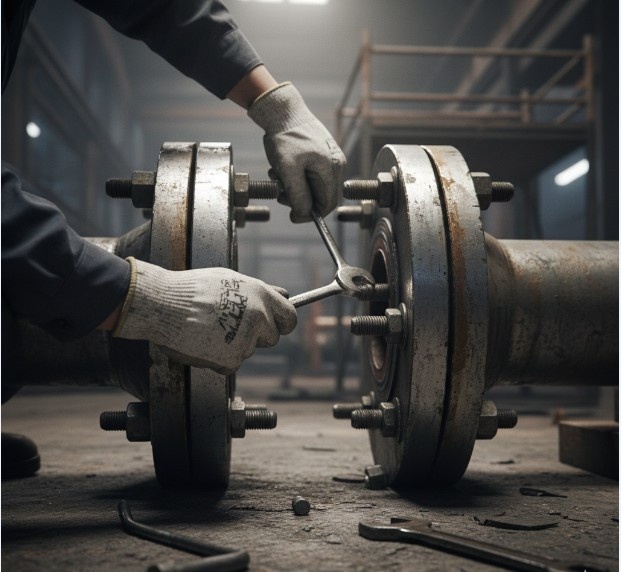
Flange Installation Errors: Common Mistakes & Prevention Tips
Flanges are critical components in piping systems, providing a reliable connection point for pipelines, valves, and equipment. However, improper installation can lead to leaks, operational downtime, and safety hazards.
Understanding common flange installation mistakes and how to avoid them ensures optimal system performance and longevity.
Flange Installation Mistakes and Their Prevention Tips
Installing flanges correctly is critical for the safety and efficiency of your piping system. Incorrect installation can lead to leaks, operational downtime, and equipment damage. To ensure optimal performance, always use high-quality flanges, which meet global standards and provide reliable connections.
Below are the most frequent flange installation mistakes and their recommended prevention techniques.
Misalignment of Flanges
One of the most frequent errors in flange installation is misalignment. Improper alignment can cause uneven stress distribution, leading to gasket failure and pipeline leaks. Always ensure flanges are aligned both axially and radially before tightening bolts.
Causes of Misalignment
Misalignment often occurs due to pipe sag, thermal expansion, or inaccurate fabrication. Using laser alignment tools or proper measuring techniques can help maintain precise flange positioning.
Prevention Techniques
- Inspect flange faces for damage before installation
- Use alignment pins or guide rods for large flanges
- Gradually tighten bolts in a cross pattern to avoid twisting.
For projects requiring precise fit and alignment, a slip-on flange can simplify installation and improve system reliability.
Incorrect Gasket Selection
Choosing the wrong flange gasket is another common issue. Gaskets must match the pressure rating, material compatibility, and flange type to prevent leaks. Using a gasket with insufficient chemical resistance can lead to premature failure.
Material Considerations
Select gaskets based on media type, temperature, and pressure. For example, PTFE gaskets are ideal for corrosive chemicals, while spiral wound gaskets suit high-pressure systems.
Installation Best Practices
Ensure the gasket is centered properly and avoid over-compressing, as both can compromise sealing integrity. Always follow manufacturer torque specifications for bolting. For safely sealing closed ends, consider using blind flanges designed for leak-proof performance.
Improper Bolt Tightening
Bolt tightening errors, such as uneven torque or using the wrong bolt material, frequently cause flange leaks.Both extremes are harmful: over‑tightening crushes gasket material, under‑tightening leaves inadequate clamping force.
Using a calibrated torque wrench and a criss‑cross tightening pattern (often across three stages: 30%, 60%, and 100% of target torque) ensures uniform compression. This method distributes load evenly and reduces stress concentrations that can warp flanges.
Torque Techniques
- Use a calibrated torque wrench
- Tighten bolts incrementally in a cross pattern
- Apply lubricant where specified to achieve uniform torque
Surface Damage and Contamination
Flange faces must be clean and free from scratches, nicks, or debris. Surface imperfections compromise gasket sealing, leading to pressure loss or chemical leaks.
Inspection Guidelines
- Examine flange faces visually and with feeler gauges
- Clean surfaces with non‑abrasive tools and approved solvents
- Avoid handling flanges with bare hands to reduce contamination
Ignoring Thermal Expansion and Pipe Stress
Temperature changes cause materials to expand and contract, which affects bolt preload and gasket compression over time. This is especially pronounced in high‑temperature or cyclic conditions.
Failure to consider thermal expansion or external pipe stresses can warp flanges and stress the connection. This is especially critical in steam, chemical, or high-temperature pipelines.
Mitigation Strategies
- Use expansion joints where appropriate
- Support pipes to minimize stress on flanges
- Conduct stress analysis during system design
Skipping Retorquing After Initial Operation
Gaskets can relax after 24 hours or post-heating cycles, reducing joint compression and sealing efficiency.
How to Prevent Retorquing Problems
- Re-check bolt torque after 24 hours or after the system reaches operating temperature
- Follow manufacturer’s retorque schedule for optimal performance
Overlooking Flange Standards and Ratings
Flanges come in various standards such as ANSI, DIN, and JIS. Installing a flange that does not meet system pressure or temperature ratings can lead to catastrophic failures. For high-pressure or welded connections, a socket weld flange ensures long-term durability and reliability.
Compliance Tips
- Verify flange pressure class matches system requirements
- Check material certifications and traceability
- Document installation to ensure regulatory compliance
Best Practices for Flange Installation
- Inspection: Always check flanges, bolts, and gaskets for defects before installation
- Use Correct Tools: Calibrated torque wrenches and proper-sized tools ensure accuracy
- Documentation: Record torque, alignment, and material info for compliance and maintenance
- Training: Ensure staff are trained in best practices for bolt tightening, gasket handling, and alignment
FAQs
What is the most common flange installation mistake?
The most frequent error is uneven bolt tightening, leading to unequal gasket compression and leaks if not corrected. Uniform torque application in a cross pattern minimizes this risk.
How often should flange bolts be retightened after installation?
Flange bolts should be checked and possibly retorqued after initial startup and thermal cycling, especially in high‑temperature systems. Regular maintenance schedules help maintain seal integrity.
Can I reuse a gasket during flange reinstallation?
No; once compressed, gaskets lose elasticity and sealing ability, increasing the risk of leaks when reused. Always install a new gasket for reliable sealing.
What torque sequence should be used for flange bolts?
Always tighten flange bolts in a star or criss‑cross pattern and do it incrementally to ensure even gasket compression and prevent joint distortion.
Conclusion
Proper flange installation is essential for ensuring safety, preventing leaks, and maintaining the efficiency of piping systems. Addressing bolt tightening, gasket selection, flange alignment, torque accuracy, surface condition, and thermal expansion minimizes operational failures and extends equipment life. Following best practices, performing inspections, and using the right tools ensures reliable, long-term performance.
Sourcing from a trusted supplier guarantees quality and consistency, and K. Hashim LLC is a leading flange and coupling supplier in the UAE, providing premium components and expert guidance for industrial, chemical, and marine applications.
Contact our technical specialists to ensure the right solution for maximum operational efficiency.
Explore More Expert Insights
Explore our expert insights to stay updated on the latest piping solutions, flange types, and industrial best practices.
- Everything You Need to Know About Camlock Couplings: Complete guide to camlock couplings, selection, and safe usage.
- Rubber vs Metal Expansion Joints: Which Is Better: Comparing durability and performance of rubber and metal expansion joints.
- Flanges for Piping Systems: Types, Uses & Applications: A complete guide to flange types, uses, and industry applications.
- Difference Between Seamless vs Welded Pipe: Understand the key differences to choose the perfect pipe for your project.
- Epoxy vs Polyurethane Coatings: Which One Is Better?: Choosing the right coating for maximum protection and durability.
Popular Posts

April 4, 2024

April 22, 2024


May 28, 2024