
- Abrasives & Drilling
- Buttweld Fittings
- Camlock Couplings and Fittings
- Clamps & Couplings
- Deck & Engine Store Supplies
- Fasteners & Hardware
- Fittings & Flanges
- Gaskets
- High-Pressure Pipe Fittings
- Hoses
- Industrial Epoxies & Spray Coatings
- Industrial Fasteners – Bolts, Nuts & Screws
- Industrial Gaskets & Sealing Products
- Lifting & Rigging
- Marine
- Marine Valves & Flow Control Solutions
- Oilfield & Industrial Supplies
- Packing & Industrial Materials
- Pipe Couplings & Expansion Joints
- PPE & Chemicals
- Safety
- Safety Items & Personal Protective Equipment
- Steel Flanges for Piping Systems
- Tools
- Valves
- Industrial Area 1, Sharjah, UAE
- sales@khashim.com
- info@khashim.com
- +971 6 533 8006
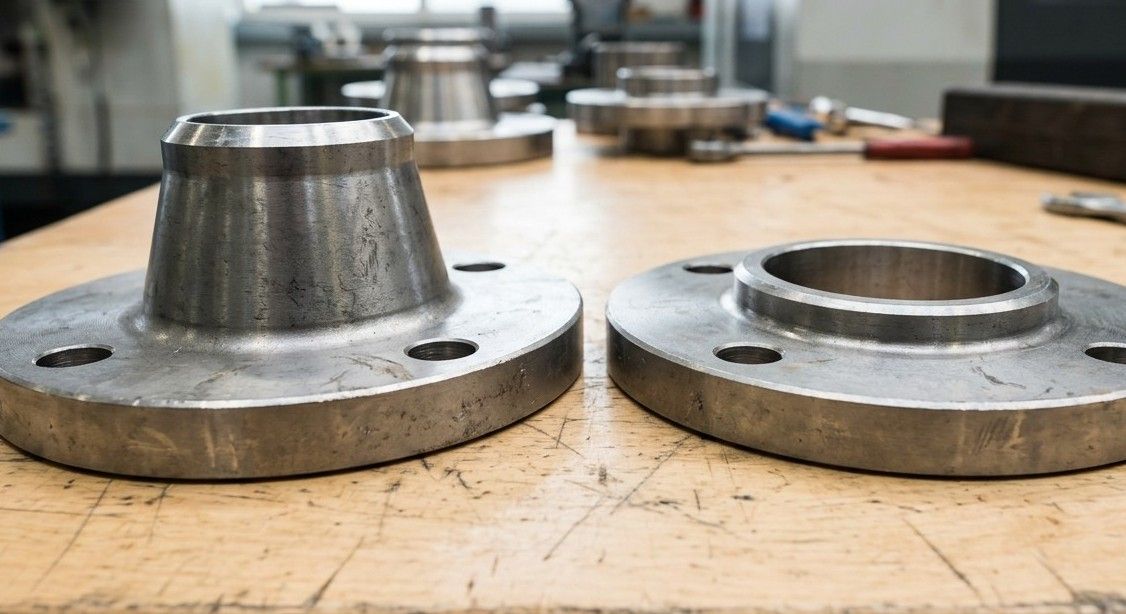
Weld Neck Vs Slip On Flanges Which Should You Choose
Get the flange wrong and you will not find out until the line is already under pressure.
Across oil and gas, water treatment, HVAC and general industrial piping, weld neck flanges and slip on flanges are the two designs engineers reach for most often. Both connect pipes, valves and equipment to the same ASME B16.5 dimensions, yet the way each one is built and welded changes how it handles stress, heat and vibration over the life of the system.
Choose poorly and the result is either a leak waiting to happen or money spent on strength a low pressure line never needed. Here is how the two compare and which one your project calls for.
What Is A Weld Neck Flange
A weld neck flange is built around a long tapered hub that narrows gradually from the flange body into the pipe wall. That taper does real work, spreading load evenly across the joint instead of letting stress pile up in one place.
The flange meets the pipe through a single full penetration butt weld, the same weld used to join one length of pipe to another. Because the bore lines up with the pipe bore, flow passes through with very little turbulence.
The design also pays off at inspection time, since that butt weld can be checked with radiographic or ultrasonic testing, giving engineers confidence in the joint before the line ever sees pressure.
These weld neck flanges are machined to standard pipe schedules in carbon steel, stainless steel and alloy grades, for exactly the high pressure and high temperature lines this design was built to handle.
What Is A Slip On Flange
A slip on flange takes a simpler approach. It is a flat ring with a bore just large enough for the pipe to slide through.
Once it is in position, two fillet welds hold it in place, one on the outer face and one on the inner bore. There is no tapered hub here, so the transition from pipe to flange happens more abruptly than it does on a weld neck design.
That simplicity is the point. Slip on flanges go on faster, align more easily and forgive a pipe that was cut slightly long or short, all while costing less to produce. The same material range is available as slip on flanges for cooling water, compressed air, HVAC and other utility lines where speed and cost outweigh the need for extreme pressure ratings.
Weld Neck Vs Slip On Flange Key Differences
The table below lines up both flange types against the factors that actually decide a specification.
| Factor | Weld Neck Flange | Slip On Flange |
|---|---|---|
| Weld Type | Single full penetration butt weld | Two fillet welds |
| Stress Distribution | Gradual through tapered hub | More concentrated at weld toe |
| Bore Alignment | Matches pipe bore exactly | Slightly larger than pipe |
| Fatigue Resistance | Higher | Lower |
| Weld Inspection | Radiographic or ultrasonic testing possible | Surface testing only |
| Installation Speed | Slower, needs precise alignment | Faster, easier fit up |
| Material Cost | Higher | Lower |
| Best Suited For | High pressure and critical service | Low to moderate pressure service |
When To Choose A Weld Neck Flange
Reach for a weld neck flange whenever a joint cannot fail.
- High pressure systems rated Class 300 and above
- High temperature lines that expand and contract often
- Piping near pumps or compressors that creates vibration
- Lines carrying hazardous, toxic or flammable fluids
- Projects where the weld must pass radiographic testing
- Systems where long term reliability matters more than upfront cost
When To Choose A Slip On Flange
A slip on flange earns its place wherever conditions stay steady and budget matters as much as build.
- Low pressure utility lines such as cooling water or compressed air
- HVAC and general building piping
- Water treatment and distribution networks
- Temporary, test or bypass connections
- Large diameter, low pressure lines where material cost matters most
- Sites where pipe length on the ground may vary slightly
Cost And Installation Comparison
A slip on flange almost always costs less than its weld neck equivalent, simply because it uses less material and a simpler welding method.
How much you actually save depends on size and pressure class, as the table below shows.
| Pressure Class | Typical Cost Gap | Installed Cost Note |
|---|---|---|
| Class 150 | Slip on runs around 20 to 30 percent cheaper | Gap narrows once welding labour is added |
| Class 300 | Slip on stays moderately cheaper | Extra weld inspection can close the gap |
| Class 600 and above | Weld neck is usually required | Cost difference becomes far less relevant |
Whatever the size, total installed cost should weigh in welding labour and inspection, not just the sticker price of the flange itself.
Where To Source Flanges In The UAE
Beyond weld neck and slip on types, K. Hashim LLC works as a complete flanges supplier in UAE.
The range covers blind, lap joint, plate, socket weld, spectacle and threaded flanges in carbon steel, stainless steel and alloy grades, so every flanged connection on a project can come from one source.
Conclusion
Both weld neck and slip on flanges earn their place once the operating conditions are clear.
Weld neck flanges suit high pressure, high temperature and cyclic service where strength and inspection matter most, while slip on flanges suit stable, low pressure utility lines where cost and installation speed take priority.
Weigh up pressure class, temperature, vibration and what a leak would cost you before you order, and the right choice becomes obvious.
Get Expert Help Choosing The Right Flange For Your Project
Getting the choice between weld neck and slip on flanges right protects the safety, performance and long term cost of a piping system.
K Hashim LLC supplies certified weld neck and slip on flanges across multiple sizes, classes and materials for oil and gas, construction and industrial projects throughout the UAE.
Reach out to our team for guidance on choosing the right flange for your system.
Explore More Expert Insights
Explore our expert insights to stay updated on the latest piping solutions, flange types, and industrial best practices.
- Unlocking Potential of Stainless Steel Grease Nipples in UAE Industries: Corrosion resistant solutions for heavy industrial performance.
- Top Applications for Stainless Steel Grease Nipples in Heavy Machinery: Real world industrial use cases improving lubrication efficiency.
- Why Stainless Steel Grease Nipples Are Essential for Corrosion-Prone Environments: Protection driven lubrication for harsh operating conditions.
- What is Wool Felt Sheet? Types, Properties and Uses: Wool felt sheet explained with types, properties, and industrial uses.
- Key Points for Maintenance and Upkeep of Marine Valves: Essential tips to keep your marine valves performing reliably.
Popular Posts

April 4, 2024

April 22, 2024


May 28, 2024