
- Abrasives & Drilling
- Buttweld Fittings
- Camlock Couplings and Fittings
- Clamps & Couplings
- Deck & Engine Store Supplies
- Fasteners & Hardware
- Fittings & Flanges
- Gaskets
- High-Pressure Pipe Fittings
- Hoses
- Industrial Epoxies & Spray Coatings
- Industrial Fasteners – Bolts, Nuts & Screws
- Industrial Gaskets & Sealing Products
- Lifting & Rigging
- Marine
- Marine Valves & Flow Control Solutions
- Oilfield & Industrial Supplies
- Packing & Industrial Materials
- Pipe Couplings & Expansion Joints
- PPE & Chemicals
- Safety
- Safety Items & Personal Protective Equipment
- Steel Flanges for Piping Systems
- Tools
- Valves
- Industrial Area 1, Sharjah, UAE
- sales@khashim.com
- info@khashim.com
- +971 6 533 8006
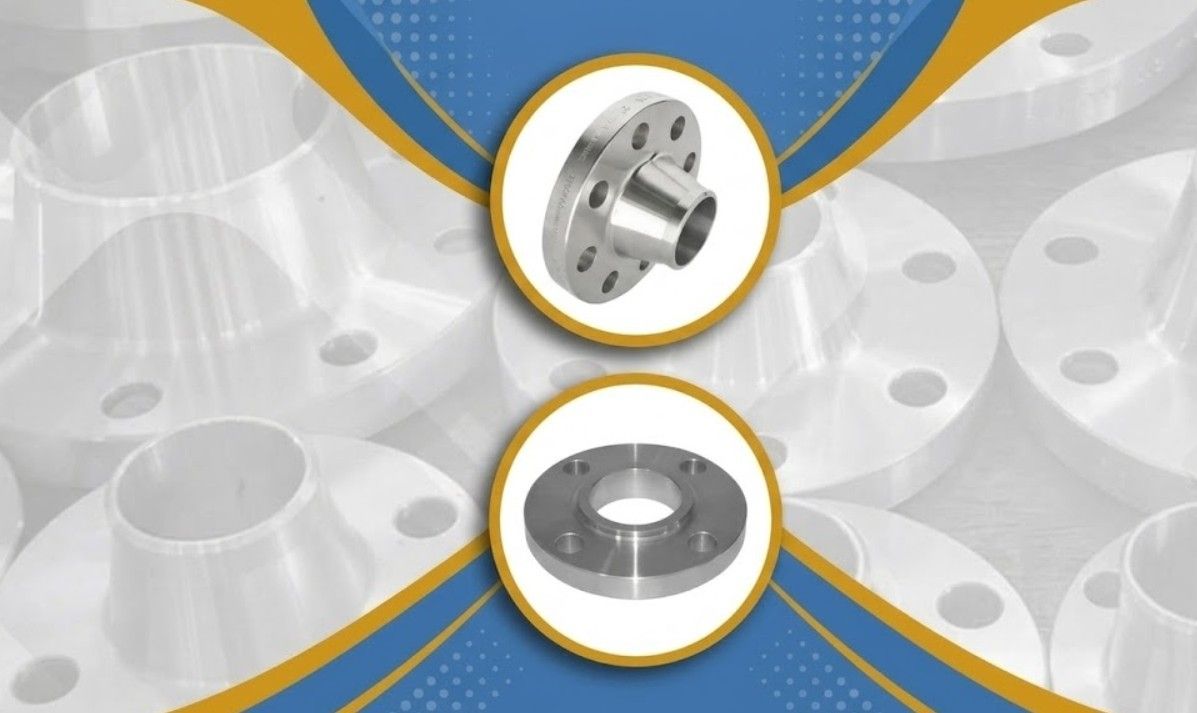
Weld Neck vs. Slip-On Flanges: Which One Should You Choose?
Choosing the wrong flange type can lead to leaks, system failures, costly downtime, and serious safety risks. When comparing weld neck vs. slip-on flanges, the right choice depends on your operating pressure, temperature, installation requirements, and long-term reliability needs.
This guide breaks down the key differences, technical specifications, and ideal applications for both flange types helping you make the right decision for your piping system.
What Is a Weld Neck Flange?
A weld neck flange features a long tapered hub that gradually transitions into the pipe wall, distributing stress evenly across the joint. It connects to the pipe via a full-penetration butt weld, which can be radiographically or ultrasonically tested to verify weld integrity under ASME B16.5 and ASME B31.3 requirements.
The tapered hub is the defining feature: it transfers load progressively into the pipe wall, minimizing stress concentration at the joint. This makes weld neck flanges the preferred choice wherever structural integrity and inspect ability are non-negotiable.
Where Weld Neck Flanges Perform Best
- High-pressure and high-temperature piping systems
- Oil and gas pipelines and petrochemical operations
- Refinery and offshore platform installations
- Power generation steam systems
- Cryogenic fluid handling
- Any service where joint failure carries catastrophic consequences
What Is a Slip-On Flange?
A slip-on flange slides over the pipe end and is secured with two fillet welds — one on the hub face and one at the internal bore. The bore is machined slightly larger than the pipe outside diameter, allowing easy alignment and faster fit-up before welding.
Without the tapered hub found on weld neck flanges, slip-on flanges are simpler to install and more economical to procure. However, the fillet weld design offers less structural integrity, making them best suited to lower-pressure, lower-risk applications.
Where Slip-On Flanges Are the Practical Choice
- Water distribution and utility piping
- HVAC and cooling systems
- General industrial and low-pressure service lines
- Food and beverage processing
- Maintenance, repair, and retrofit scenarios
Weld Neck vs. Slip-On Flanges: Key Technical Differences
1. Strength and Pressure Tolerance
The tapered hub of a weld neck flange transfers load gradually into the pipe wall, reducing stress concentration and supporting pressure ratings up to Class 2500 under ASME B16.5. Slip-on flanges rely on two fillet welds, which are inherently less robust. Their effective pressure capacity is typically around two-thirds that of an equivalent weld neck under the same class rating, making them suitable for low-to-medium pressure applications only.
2. Welding Method
Weld neck flanges use a full-penetration butt weld, which forms a seamless, high-integrity connection with the pipe. Slip-on flanges use two fillet welds — faster to deposit, but less structurally sound. The fillet weld creates a geometric discontinuity at the weld toes, which becomes a potential fatigue initiation point under cyclic or dynamic loading.
3. Radiographic Testing and Code Compliance
The butt weld on a weld neck flange can be radiographically tested (RT) or ultrasonically tested (UT) to confirm internal weld integrity, as required under ASME B31.3 and API 570 for critical service. Fillet welds on slip-on flanges cannot be RT examined. This typically excludes them from Category M fluid service, lethal service designations, and any application where full volumetric weld examination is mandatory.
4. Fatigue and Cyclic Load Performance
In systems subject to vibration, thermal cycling, or pressure surges, the butt-weld joint of a weld neck flange delivers superior fatigue resistance due to more uniform stress distribution. Slip-on fillet welds are more susceptible to fatigue cracking under repeated dynamic loading and are generally not recommended where cyclic conditions are significant.
5. Installation Complexity
Slip-on flange installation is faster and less skill-intensive. The pipe slides through the bore without demanding precise fit-up, reducing labour costs in maintenance or retrofit scenarios. Weld neck flanges require accurate pipe preparation, careful alignment, and qualified welding procedures — but this investment directly supports long-term joint reliability in systems that are costly or difficult to access later.
6. Flow Characteristics
A weld neck flange can be bored to match the pipe inside diameter exactly, producing a smooth, uninterrupted flow path that minimises turbulence and erosion in corrosive or flow-sensitive services. Slip-on flanges may introduce a minor bore step at the pipe junction — negligible in most general service applications, but relevant in precise flow measurement or sanitary piping systems.
Comparison Table: Weld Neck vs. Slip-On Flanges
| Feature | Weld Neck Flange | Slip-On Flange |
|---|---|---|
| Weld Type | Full-penetration butt weld | Two fillet welds |
| Pressure Rating | Class 150 to 2500 | Typically Class 150 to 300 |
| Temperature Service | High temperature compatible | Low to moderate |
| Radiographic Testing | Yes, fully testable | Not applicable |
| Fatigue Resistance | Excellent | Limited |
| Installation Complexity | Higher skill required | Simple and fast |
| Unit Cost | Higher | Lower |
| Best Application | Critical and high-integrity service | General and utility service |
Material Options for Both Flange Types
Both weld neck and slip-on flanges are available across a wide range of materials to suit different service environments. As a trusted flanges supplier in UAE, stocks all major grades and standards:
- ASTM A105 carbon steel — standard pressure and temperature applications
- ASTM A182 F304 / F316 stainless steel — corrosive, hygienic, or chemical environments
- ASTM A182 F11 / F22 alloy steel — elevated temperature service
- Duplex and super-duplex stainless steel — aggressive chloride or offshore conditions
Material selection must account for the process fluid, operating temperature, external environment, and applicable code requirements.
Cost Considerations: Beyond the Unit Price
Slip-on flanges are typically 20–40% cheaper to purchase than equivalent weld neck flanges. However, unit price alone does not tell the full story. Total installed cost includes welder labour, weld inspection, testing, and the potential expense of future maintenance or failure.
In low-pressure utility systems, slip-on flanges offer genuine value. In high-temperature or high-pressure service at Class 600 and above, the modest price saving can be far outweighed by the cost of a single joint failure, production shutdown, or safety incident.
How to Choose Between Weld Neck and Slip-On Flanges
Use the following criteria to guide your selection:
Choose a weld neck flange when:
- Operating pressure exceeds Class 300 or involves high temperatures
- The system is subject to vibration, thermal cycling, or pressure surges
- The process fluid is hazardous, toxic, or highly flammable
- Code compliance requires volumetric weld examination (RT/UT)
- Long-term reliability is critical and access for repair is limited
Choose a slip-on flange when:
- The system operates at low to medium pressure
- The fluid is non-hazardous and consequences of leakage are manageable
- Installation speed and lower upfront cost are priorities
- The piping specification explicitly permits fillet-weld construction
Applications at a Glance
Weld Neck Flange Applications: Oil and gas pipelines, petrochemical and refinery operations, high-pressure steam systems, power generation, offshore platforms, chemical reactors, rotating equipment discharge lines.
Slip-On Flange Applications: Water distribution, HVAC and cooling loops, compressed air and nitrogen lines, firewater mains, food and beverage processing, general utility and maintenance piping.
Conclusion
The choice between weld neck and slip-on flanges comes down to operating conditions, service criticality, and long-term cost. Weld neck flanges deliver superior strength, fatigue resistance, and code compliance for demanding, high-integrity applications. Slip-on flanges offer a practical, cost-effective solution for stable, low-pressure utility services.
Hashim LLC supplies high quality flanges and piping components designed to meet the demands of industrial operations across the UAE — from standard utility systems to critical high-pressure installations.
Partner with our flanges specialists for dependable flange solutions tailored to your project specifications and operating requirements.
Explore More Expert Insights
Explore our expert insights to stay updated on the latest piping solutions, flange types, and industrial best practices.
- Unlocking Potential of Stainless Steel Grease Nipples in UAE Industries: Corrosion resistant solutions for heavy industrial performance.
- Top Applications for Stainless Steel Grease Nipples in Heavy Machinery: Real world industrial use cases improving lubrication efficiency.
- Why Stainless Steel Grease Nipples Are Essential for Corrosion-Prone Environments: Protection driven lubrication for harsh operating conditions.
- What is Wool Felt Sheet? Types, Properties and Uses: Wool felt sheet explained with types, properties, and industrial uses.
- Key Points for Maintenance and Upkeep of Marine Valves: Essential tips to keep your marine valves performing reliably.
Popular Posts

April 4, 2024

April 22, 2024


May 28, 2024