
- Abrasives & Drilling
- Buttweld Fittings
- Camlock Couplings and Fittings
- Clamps & Couplings
- Deck & Engine Store Supplies
- Fasteners & Hardware
- Fittings & Flanges
- Gaskets
- High-Pressure Pipe Fittings
- Hoses
- Industrial Epoxies & Spray Coatings
- Industrial Fasteners – Bolts, Nuts & Screws
- Industrial Gaskets & Sealing Products
- Lifting & Rigging
- Marine
- Marine Valves & Flow Control Solutions
- Oilfield & Industrial Supplies
- Packing & Industrial Materials
- Pipe Couplings & Expansion Joints
- PPE & Chemicals
- Safety
- Safety Items & Personal Protective Equipment
- Steel Flanges for Piping Systems
- Tools
- Valves
- Industrial Area 1, Sharjah, UAE
- sales@khashim.com
- info@khashim.com
- +971 6 533 8006
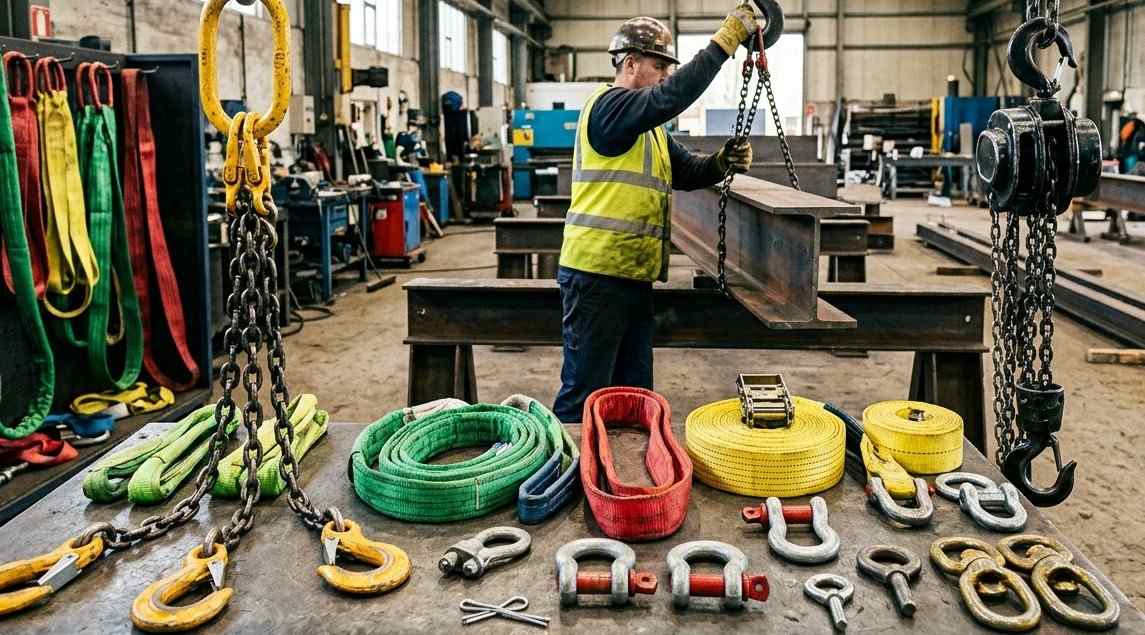
Essential Lifting Accessories for Every Job Site
Lifting operations are common across construction, manufacturing, warehouses, oil and gas, marine, and industrial sites. Safe and efficient lifting depends on more than cranes, hoists, or forklifts. The right lifting accessories help connect, secure, position, and control loads.
From lifting slings and shackles to lifting hooks and spreader beams, each accessory has a specific purpose. Choosing the correct equipment improves load control, reduces damage, and supports safer lifting operations.
1. Webbing Slings
Webbing slings are flexible, lightweight lifting accessories made from high-strength synthetic material. They are widely used for machinery, pipes, structural components, and other loads.
Their soft surface helps reduce the risk of scratching finished materials. When choosing one, check its working load limit (WLL), length, width, and lifting configuration.
2. Wire Rope Slings
Wire rope slings are designed for demanding applications where strength, durability, and abrasion resistance are important. They are common in construction, steel fabrication, shipyards, and industrial plants.
Inspect them regularly for broken wires, corrosion, kinks, crushing, and other damage. Select the correct rope construction and capacity for the intended load.
3. Chain Slings
Chain slings are suitable for heavy lifting and applications involving sharp edges, rough surfaces, or higher temperatures. They are available in single-leg, two-leg, three-leg, and four-leg configurations.
Choose chain slings according to the required capacity, chain grade, lifting angle, and load configuration.
4. Lifting Shackles
Shackles provide secure connections between lifting slings, chains, hooks, and loads. Common types include bow shackles and D shackles each suited to different connection and loading requirements.
Bow shackles provide a wider opening for multiple connections, while D shackles are suited to more direct loading. Always check the shackle’s working load limit before use.
5. Lifting Hooks
Lifting hooks connect cranes, hoists, chain blocks, and slings to loads. Many hooks include safety latches to help prevent accidental disengagement.
Inspect hooks for cracks, deformation, excessive wear, and damaged latches. Replace damaged hooks immediately.
6. Eye Bolts and Lifting Eye Nuts
Eye bolts and lifting eye nuts create attachment points for machinery, structures, equipment, and fabricated components.
Select the correct type based on the lifting direction and application. Always follow the manufacturer’s specifications, especially when lifting at an angle.
7. Spreader Beams
Spreader beams help distribute loads during lifting and are useful for long or wide materials. They can reduce sling angles and improve load stability.
Spreader beams for lifting are commonly used for pipes, steel structures, tanks, machinery, and large fabricated components. Complex lifts should be properly planned before work begins.
8. Lifting Clamps
Lifting clamps provide a temporary gripping point for materials such as steel plates and sheets. They are widely used in fabrication shops, warehouses, and construction sites.
Choose a clamp according to the material type, thickness, lifting direction, and rated capacity. Never exceed its working load limit.
9. Load Binders and Chain Tensioners
Load binders secure materials during transportation and are common in construction, logistics, trucking, and industrial applications.
They work with chains to hold pipes, steel sections, machinery, and other materials in position. Remember that load binders are primarily for load securing, not lifting, unless specifically rated for that purpose.
10. Lifting Magnets
Lifting magnets are useful for handling ferrous materials such as steel plates, pipes, and fabricated components. They can provide quick handling without conventional slings in suitable applications.
Before use, check the magnet’s capacity and the load’s thickness, surface condition, shape, and contact area. These factors can affect lifting performance.
How to Choose the Right Lifting Accessories
Start by evaluating the load weight, dimensions, center of gravity, lifting points, surface condition, and working environment.
Check the working load limit of every component in the lifting system. Capacity can also change based on sling configuration and lifting angles.
Before each operation, inspect accessories for cuts, deformation, corrosion, broken wires, damaged stitching, worn components, and missing identification tags.
Why Quality Lifting Accessories Matter
Quality industrial lifting equipment supports safer and more controlled material handling. Poorly selected or damaged accessories can increase the risk of load movement and equipment failure.
Choose lifting accessories with clear identification, suitable capacity ratings, and manufacturer documentation where required. Regular inspections, proper storage, and operator training are also essential.
Final Thoughts
The right lifting accessories for job sites improve safety, load control, and handling efficiency. Webbing slings, wire rope slings, chain slings, shackles, hooks, eye bolts, spreader beams, lifting clamps, load binders, and lifting magnets each serve different purposes.
For reliable marine and industrial lifting equipment, K. Hashim LLC offers solutions for demanding industrial applications. Contact our team to discuss your lifting equipment requirements and find the right products for your job site.
Explore More Expert Insights
Explore our expert insights to stay updated on the latest piping solutions, flange types, and industrial best practices.
- Unlocking Potential of Stainless Steel Grease Nipples in UAE Industries: Corrosion resistant solutions for heavy industrial performance.
- Top Applications for Stainless Steel Grease Nipples in Heavy Machinery: Real world industrial use cases improving lubrication efficiency.
- Why Stainless Steel Grease Nipples Are Essential for Corrosion-Prone Environments: Protection driven lubrication for harsh operating conditions.
- What is Wool Felt Sheet? Types, Properties and Uses: Wool felt sheet explained with types, properties, and industrial uses.
- Key Points for Maintenance and Upkeep of Marine Valves: Essential tips to keep your marine valves performing reliably.
Popular Posts

April 4, 2024

April 22, 2024


May 28, 2024