
- Abrasives & Drilling
- Buttweld Fittings
- Camlock Couplings and Fittings
- Clamps & Couplings
- Deck & Engine Store Supplies
- Fasteners & Hardware
- Fittings & Flanges
- Gaskets
- High-Pressure Pipe Fittings
- Hoses
- Industrial Epoxies & Spray Coatings
- Industrial Fasteners – Bolts, Nuts & Screws
- Industrial Gaskets & Sealing Products
- Lifting & Rigging
- Marine
- Marine Valves & Flow Control Solutions
- Oilfield & Industrial Supplies
- Packing & Industrial Materials
- Pipe Couplings & Expansion Joints
- PPE & Chemicals
- Safety
- Safety Items & Personal Protective Equipment
- Steel Flanges for Piping Systems
- Tools
- Valves
- Industrial Area 1, Sharjah, UAE
- sales@khashim.com
- info@khashim.com
- +971 6 533 8006
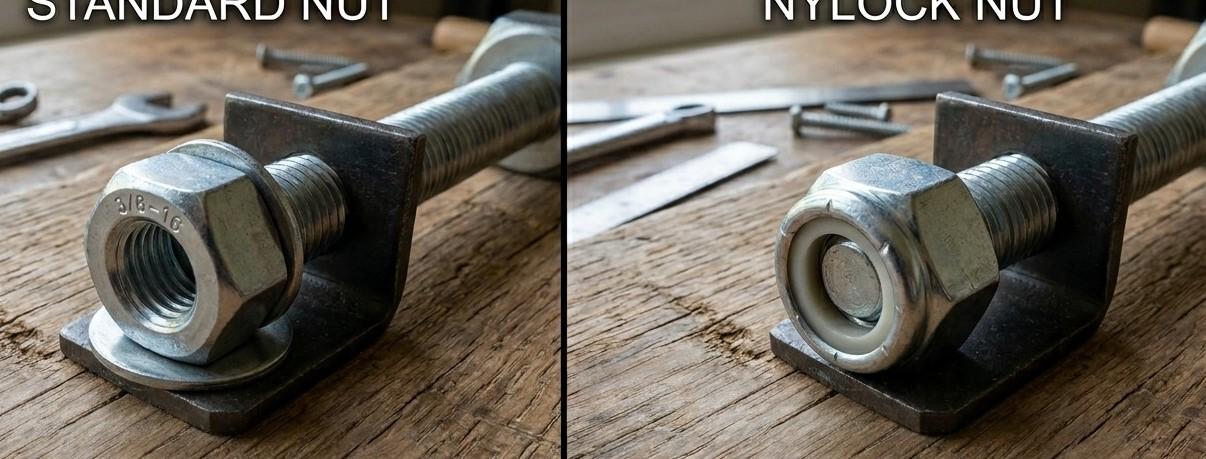
Nylock nuts vs Standard Nuts: Key Differences Explained
In industrial and mechanical applications, loose fasteners can lead to equipment damage, maintenance issues, and safety risks. Choosing between a Nylock nut and a standard nut is important for maintaining secure threaded connections, especially in environments exposed to vibration and dynamic loads.
Although both fasteners serve the same basic purpose, their locking mechanisms work very differently. Standard nuts rely on thread friction and clamp force, while Nylock nuts use a nylon insert that creates prevailing torque to resist loosening during operation.
This guide explains the differences between Nylock nuts and standard nuts, including vibration resistance, temperature performance, reusability, and material options. It also helps identify which fastening solution is best suited for specific industrial and mechanical applications.
What Is a Standard Nut?
A standard nut, often called a hex nut, is the most widely used fastening component in mechanical assemblies worldwide. It threads onto a bolt and is torqued down to a specified value, generating a clamping force between the mating surfaces.
That clamping force creates friction between the threads, and friction is what holds the joint together. Standard nuts depend entirely on preload to stay in position since they carry no independent locking feature of their own.
In a perfectly static environment this friction keeps the nut in place for years. The moment an assembly starts to vibrate, however, the nut becomes vulnerable to gradual rotation and backing off.
Standard nuts conform to DIN 934 or ANSI B18.2.2 and come in a range of materials and grades. Key characteristics include:
- Available in carbon steel, stainless steel, brass, and alloy steel
- Free-spinning design allows fast hand installation before final torque
- Unlimited reusability as long as threads remain undamaged
- Lower unit cost compared to any locking nut variant
- Require additional measures like lock washers in vibrating environments
What Is a Nylock nut?
A Nylock nut, also called a nylon insert lock nut, features a nylon collar embedded in the top portion of the nut. When bolt threads reach this collar they must force their way through the nylon, which deforms slightly and grips the bolt with consistent compressive pressure.
This grip is what makes the Nylock nut fundamentally different. The locking action does not come from bolt tension or clamp force but from the mechanical interference between the nylon and the thread flanks.
This means the nut resists rotation even when vibration reduces or eliminates the original clamp load. The nylon insert is typically made from polyamide, which retains its elastic recovery properties across a wide temperature range for general industrial use.
Core features of a Nylock nut include:
- Nylon collar permanently bonded inside the top of the nut body
- Prevailing torque that holds the nut even after bolt tension is lost
- Dimensional compliance to ISO 7042 or ISO 7043 depending on variant
- Available in steel, stainless steel, and titanium base materials
- Not free-spinning, requiring a wrench through the nylon engagement zone
How the Locking Mechanism Actually Works
When a standard nut is tightened, the friction holding it in place comes from two contact zones. The first is between the underside of the nut and the bearing surface, and the second is between the mating thread flanks of the nut and bolt.
Research using the Junker vibration test, the globally accepted standard for fastener loosening behavior, consistently shows that transverse vibration overcomes these friction zones far more easily than axial loading. Once friction drops below the self-loosening threshold, the nut begins to back off one microscopic increment at a time.
A Nylock nut adds a third retention mechanism that does not depend on thread friction at all. The nylon collar creates prevailing torque, which is resistance that exists independently of bolt tension.
Even if vibration strips away all clamp load, the nylon still grips the bolt and holds the nut in position. Laboratory testing confirms that Nylock nuts retain their position through thousands of vibration cycles where standard nuts have already fully backed off.
Key Differences Between Nylock nuts and Standard Nuts
The table below summarizes the most important performance and application differences between the two nut types to support clear procurement decisions.
| Feature | Standard Nut | Nylock Nut |
|---|---|---|
| Locking Mechanism | Thread friction only | Nylon insert creates prevailing torque |
| Vibration Resistance | Low | High |
| Temperature Limit | Limited by material only | Nylon softens around 120–250°C |
| Reusability | Unlimited | Reduced after each removal |
| Installation Torque | Standard torque at seating only | Higher torque required through nylon zone |
| Typical Materials | Carbon steel, stainless steel, brass | Steel or titanium with nylon insert |
| Thread Damage Risk | Minimal | Low, nylon adds slight resistance |
| Cost | Lower upfront | Higher upfront, lower lifecycle cost |
| Best Environment | Static, non-vibrating assemblies | Dynamic loads, vibration, safety-critical joints |
| Applicable Standards | DIN 934, ANSI B18.2.2 | ISO 7042, ISO 7043, DIN 985 |
Material Options and Their Significance
Both nut types are available across multiple material grades, and the right choice depends on the environmental conditions the assembly will face. The three main tiers are carbon steel, stainless steel, and titanium.
Carbon steel
Carbon steel Nylock nuts and standard nuts are the most economical option for dry indoor environments where corrosion is not a concern. They are widely used in general machinery, consumer products, and construction applications.
Stainless steel
Stainless steel versions offer improved corrosion resistance and work well in food processing, mild marine environments, and chemical handling equipment. One trade-off is that stainless on stainless can gall without lubrication, so an anti-seize compound is recommended during installation.
Titanium
Titanium represents the highest performance tier for both nut types. Titanium alloy grade 5, known as Ti-6Al-4V, delivers a tensile strength of approximately 130,000 psi at a density roughly 40 percent lower than steel.
Its passive oxide layer regenerates after surface scratching, providing corrosion resistance that far exceeds stainless steel in saltwater and acid environments.
When a reputable Nylock nuts supplier combines titanium with a high-grade nylon insert and manufactures to ISO 7043, the result is a fastener suited for aerospace, offshore, and advanced medical applications.
Titanium Nylock nuts offer specific advantages that no other material combination can match:
- Weight savings of up to 40 percent compared to equivalent steel fasteners
- Self-healing oxide layer that resists saltwater, acids, and chloride attack
- Fatigue strength retention up to 50 percent of ultimate tensile strength after one million stress cycles
- Biocompatibility making them suitable for medical device and implant tooling
- No coating required, eliminating coating wear and delamination over time
Temperature Performance and Its Limits
Temperature behavior is one of the most critical factors when selecting between these nut types, especially in industrial and mechanical environments operating near heat sources.
Standard nuts have no polymer component, so their temperature range is governed entirely by the alloy used. High-grade steel nuts can function in temperatures well above 500 degrees Celsius in non-oxidizing conditions without any loss of mechanical performance.
Nylock nuts carry a built-in temperature constraint because nylon loses its elastic recovery when heated beyond its softening point. Standard polyamide inserts begin to soften around 120 degrees Celsius and lose meaningful locking force above that threshold.
Higher-specification nylon grades extend the usable range to approximately 250 degrees Celsius. Applications involving these environments typically require an upgraded insert:
- Exhaust systems and turbocharger mounting brackets
- Heat exchanger flanges and industrial boiler connections
- Engine compartment fasteners near hot surfaces
- Industrial ovens and furnace equipment enclosures
- Hydraulic systems operating at sustained elevated temperatures
Above 250 degrees Celsius, all-metal distorted-thread locking nuts are the appropriate choice. A reliable nylock nuts supplier will provide technical data sheets showing locking torque retention at each temperature level for every product in their line.
Vibration Resistance: The Defining Test
Vibration testing is where Nylock nuts prove their value most clearly and where the limitations of standard nuts become impossible to ignore.
The Junker test applies controlled transverse vibration to a bolted joint and measures the rate at which the nut backs off. Standard hex nuts begin to loosen within the first few hundred cycles and typically reach near-zero preload within a few thousand cycles depending on amplitude and frequency.
Nylock nuts tested under identical conditions retain their position across tens of thousands of cycles. Even after bolt elongation relaxes and tension drops, the nylon collar keeps the nut from rotating backward on the thread.
Industries that have adopted Nylock nuts specifically for vibration control include:
- Automotive manufacturing for chassis, suspension, and drivetrain connections
- Commercial aviation for engine mounts, landing gear, and control surface linkages
- Rail equipment assembly for bogies and underframe structural joints
- Industrial pump and motor construction operating under continuous cyclic loads
- Marine vessels exposed to constant engine vibration and wave-induced movement
This performance advantage translates directly into reduced maintenance intervals, fewer fastener-related failures, and greater overall system reliability.
Reusability and Maintenance Considerations
One practical limitation of Nylock nuts is their reduced reusability compared to standard nuts. Each time a Nylock nut is removed from a bolt, the nylon insert undergoes some permanent deformation, so the prevailing torque on the second installation is lower than on the first.
Engineering standards and most fastener manufacturers recommend replacing Nylock nuts after disassembly, particularly in safety-critical applications. The reason is reliability rather than cost, since the price of a replacement nut is negligible compared to the risk of a failed joint.
Standard nuts can be reused indefinitely as long as threads are undamaged. This makes them the practical choice for components requiring frequent removal such as:
- Inspection panels and maintenance access covers
- Test fixtures and laboratory equipment
- Adjustable frames and production jigs
- Consumer products designed for user servicing
- Any assembly where fastener removal happens on a regular schedule
When to Choose a Nylock nut?
Selecting the right nut type starts with an honest assessment of the operating environment. Nylock nuts are the correct specification in the following situations.
The assembly experiences vibration from any source. Engine harmonics, road input, equipment cycling, and fluid pulsation all create the transverse movement that gradually backs off standard nuts over thousands of operating hours.
The joint is safety-critical and a loose fastener could cause injury or equipment failure. Applications in this category include:
- Steering linkages and tie rod ends
- Brake caliper and master cylinder mounting
- Overhead hoists and lifting equipment
- Structural connections in bridges and elevated platforms
- Aircraft control surface and landing gear assemblies
The assembly is difficult or expensive to access for routine retightening. Remote installations, buried components, and permanently enclosed assemblies benefit from the set-and-forget reliability that Nylock nuts provide between service intervals.
The joint material is soft or prone to creep such as aluminum, plastic, or composite structures. As the bearing material compresses and preload drops over time, the nylon insert keeps the fastener from backing out entirely.
When to Choose a Standard Nut?
Standard nuts remain the dominant fastener by volume for valid engineering reasons. Specifying Nylock nuts across every application adds unnecessary cost and complexity without improving performance.
Purely static structural assemblies such as building frameworks, shelving systems, and non-vibrating enclosures do not generate the transverse motion that causes loosening. Standard nuts with correct torque values are fully adequate in these conditions.
Standard nuts are also the better choice in the following scenarios:
- High-precision torque applications like cylinder head bolts where consistent friction coefficients are essential for accurate torque-to-yield readings
- Assemblies requiring frequent disassembly such as inspection panels and test fixtures where a new locking nut would be needed every time
- Cost-sensitive, low-risk applications where the consequences of a loose nut are minor and do not justify the added expense
- Applications using thread-locking compounds as the primary retention method where a nylon insert would interfere with compound adhesion
- Precision bearing preload adjustments where controlled, repeatable friction is critical to correct function
Procurement and Supplier Selection
For industrial buyers, fastener quality depends as much on the manufacturing process as on the design specification. Dimensional compliance to ISO 7043 or DIN 985 ensures interchangeability, but nylon insert consistency, bonding method, and thread accuracy all directly affect real-world locking performance.
When evaluating a Nylock nuts supplier for critical applications, the baseline requirement is ISO 9001 certification covering the full manufacturing process. Aerospace supply chains require AS9100 certification and medical applications require ISO 13485.
Beyond certification, procurement teams should verify the following before placing orders:
- Material test reports with chemical composition and mechanical property data for each batch
- Lot traceability documentation linking finished fasteners back to raw material heat numbers
- Sample locking torque test data confirming prevailing torque values meet or exceed ISO minimums
- Production capacity and minimum order quantities that align with project volume requirements
- Availability of stock in standard sizes to support urgent or unplanned maintenance requirements
Lead times for specialty sizes and materials, particularly titanium, typically range from eight to twelve weeks for custom orders. Building this into project schedules and confirming stock availability for common sizes will prevent delays during critical assembly phases.
Conclusion
The choice between Nylock nuts and standard nuts comes down to operating conditions, joint criticality, and long-term fastening reliability. Standard nuts provide a practical and cost-effective solution for static, low-vibration applications where regular maintenance and frequent disassembly are expected. Nylock nuts offer superior resistance against loosening in environments exposed to vibration, dynamic loads, and continuous movement, making them ideal for safety-critical and high-performance assemblies.
K Hashim LLC supplies premium titanium Nylock nuts and precision-engineered titanium fasteners designed to meet the demands of aerospace, marine, petrochemical, and industrial applications worldwide, from standard ISO 7043 configurations to custom manufacturing specifications.
Contact our fastener specialists for technical guidance, material certifications, and dependable fastening solutions tailored to your project requirements.
Explore More Expert Insights
Explore our expert insights to stay updated on the latest piping solutions, flange types, and industrial best practices.
- Unlocking Potential of Stainless Steel Grease Nipples in UAE Industries: Corrosion resistant solutions for heavy industrial performance.
- Top Applications for Stainless Steel Grease Nipples in Heavy Machinery: Real world industrial use cases improving lubrication efficiency.
- Why Stainless Steel Grease Nipples Are Essential for Corrosion-Prone Environments: Protection driven lubrication for harsh operating conditions.
- What is Wool Felt Sheet? Types, Properties and Uses: Wool felt sheet explained with types, properties, and industrial uses.
- Key Points for Maintenance and Upkeep of Marine Valves: Essential tips to keep your marine valves performing reliably.
Popular Posts

April 4, 2024

April 22, 2024


May 28, 2024