
- Abrasives & Drilling
- Buttweld Fittings
- Camlock Couplings and Fittings
- Clamps & Couplings
- Deck & Engine Store Supplies
- Fasteners & Hardware
- Fittings & Flanges
- Gaskets
- High-Pressure Pipe Fittings
- Hoses
- Industrial Epoxies & Spray Coatings
- Industrial Fasteners – Bolts, Nuts & Screws
- Industrial Gaskets & Sealing Products
- Lifting & Rigging
- Marine
- Marine Valves & Flow Control Solutions
- Oilfield & Industrial Supplies
- Packing & Industrial Materials
- Pipe Couplings & Expansion Joints
- PPE & Chemicals
- Safety
- Safety Items & Personal Protective Equipment
- Steel Flanges for Piping Systems
- Tools
- Valves
- Industrial Area 1, Sharjah, UAE
- sales@khashim.com
- info@khashim.com
- +971 6 533 8006
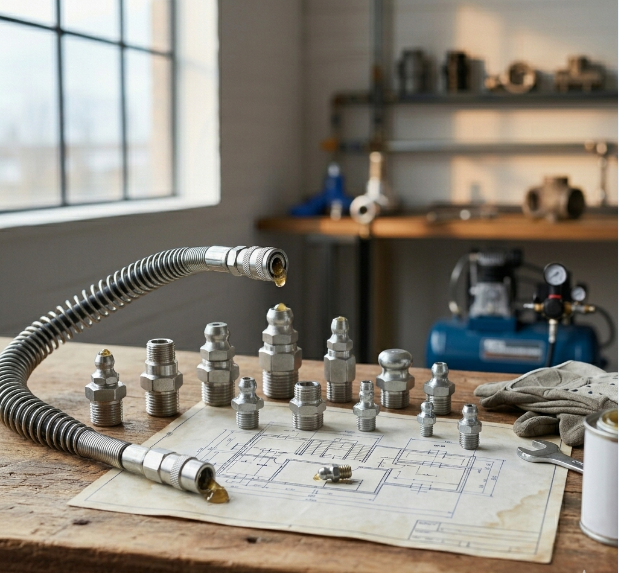
Grease Nipples Guide for Industrial Lubrication Systems
In modern mechanical environments, equipment reliability depends heavily on controlled lubrication delivery. One of the most critical yet often overlooked components enabling this process is the small fitting known as the grease nipple.
In industrial operations, efficient lubrication ensures reduced friction, minimized wear, and extended machinery life. Without proper lubrication access points, even high quality systems can experience premature failure and costly downtime.
This guide explains how lubrication fittings work, their industrial applications, and how to select the right type for different machinery environments.
How Grease Nipples Work in Lubrication Systems
A grease nipple is essentially a small check-valve system installed into machinery. When a grease gun is attached, pressure forces a ball or valve inside the fitting to open, allowing grease to flow into the lubrication channel. Once pressure is removed, the valve closes automatically to prevent leakage and contamination.
This simple mechanism ensures two critical functions:
- Controlled grease delivery into high-friction components
- Prevention of dirt, dust, and water entering the system
In industrial environments, this dual function is essential because contaminants can significantly reduce bearing life and increase maintenance costs.
Types of Grease Nipples Used in Industrial Applications
Grease nipples are not universal. Their design varies depending on equipment requirements, access space, and operating conditions.
1. Straight Grease Nipples
These are the most common type and are used where the lubrication point is easily accessible. They provide direct alignment for grease gun connection and are widely used in standard machinery.
2. Angled Grease Nipples
These include 45 degree and 90 degree designs. They are used in tight or obstructed spaces where a straight fitting cannot be accessed easily.
3. Button Head Grease Nipples
These are designed for high-volume grease delivery. They are commonly used in heavy-duty industrial equipment and construction machinery where frequent lubrication is required.
4. Flush Type Nipples
Flush fittings sit nearly level with the machine surface. They are used in environments where exposed fittings may be damaged or contaminated.
5. Thread Variants
Grease nipples are manufactured in different thread standards such as metric, BSP, and SAE depending on regional machinery standards.
Materials and Construction Quality
The performance of a grease nipple is heavily influenced by its material composition. Industrial-grade fittings are designed for harsh environments involving pressure, vibration, and corrosion exposure.
Common materials include:
- Mild steel for general applications
- Brass for moderate corrosion resistance
- Stainless steel for chemical or marine environments
- Hardened steel for high-pressure industrial systems
Stainless steel grease nipples are particularly important in food processing, marine engineering, and chemical plants due to their resistance to rust and contamination.
Industrial Applications of Grease Nipples
Grease nipples are widely used across multiple industries where continuous motion and heavy loads exist.
Manufacturing Equipment
Used in conveyor systems, rotating shafts, and assembly machinery where continuous operation is required.
Automotive and Transport Systems
Found in suspension systems, axle joints, and steering components.
Construction Machinery
Excavators, loaders, and cranes rely heavily on grease nipples for pin joints and hydraulic linkages.
Agricultural Machinery
Tractors and harvesting equipment use grease nipples to maintain bushings and rotating joints under dusty and high-load conditions.
Importance in Preventive Maintenance Systems
Industrial maintenance strategies strongly emphasize preventive lubrication. Grease nipples play a central role in this approach because they enable scheduled lubrication without dismantling equipment.
Key advantages include:
- Reduced machine downtime
- Lower maintenance cost over equipment lifespan
- Improved bearing performance under heavy load
- Extended operational life of mechanical components
A properly lubricated bearing can last several times longer than one operating under insufficient lubrication conditions. Industry data consistently shows that poor lubrication practices account for a large portion of mechanical failures in industrial environments.
Case Breakdown: Industrial Conveyor System Failure vs Proper Lubrication
Scenario Without Proper Greasing
A steel manufacturing plant experienced frequent conveyor bearing failures. Inspection revealed that grease points were either blocked or neglected due to inaccessible lubrication points. This led to overheating, metal wear, and repeated downtime.
Intervention Using Grease Nipples
The maintenance team replaced blocked lubrication points with accessible angled grease nipples and implemented a scheduled lubrication system using grease guns.
Outcome
- Bearing lifespan increased significantly
- Downtime reduced by more than half
- Maintenance costs decreased due to fewer replacements
- Improved production efficiency
This example highlights how a simple component like a grease nipple can significantly improve system reliability.
Poor Lubrication vs Proper Lubrication Case Comparison
| Aspect | Poor Lubrication | Proper Lubrication |
|---|---|---|
| Bearing Condition | Fast wear and overheating | Smooth and stable operation |
| Downtime | Frequent breakdowns | Minimal interruptions |
| Energy Use | High resistance, more power needed | Efficient and optimized |
| Lifespan | Short equipment life | Extended component life |
| Maintenance Cost | High repair costs | Lower maintenance needs |
| Grease Flow | Blocked or inconsistent | Steady and reliable |
| Reliability | Unstable performance | Consistent operation |
| Safety | Higher failure risk | Safer system performance |
Expert Perspective on Lubrication Efficiency
From an engineering maintenance perspective, grease nipples are not just accessories but essential reliability components. Experts in industrial lubrication emphasize three critical principles:
- Proper selection of nipple type based on load and accessibility
- Regular lubrication scheduling to avoid dry friction
- Protection against contamination using sealed valve designs
In high-vibration environments such as mining or heavy construction, reinforced fittings are often used to prevent loosening and mechanical failure. This ensures long-term stability even under extreme operating conditions.
Common Issues in Industrial Use
Despite their simplicity, grease nipples can fail due to operational conditions.
- Blockage
Old or degraded grease can harden inside the fitting, restricting flow and preventing fresh lubricant from entering the system effectively. - Leakage
Damaged internal check valves or worn sealing surfaces may allow grease to escape or let dirt and contaminants enter the lubrication pathway. - Mechanical Loosening
Continuous vibration in heavy machinery can gradually loosen improperly installed fittings, leading to inconsistent lubrication delivery.
AI Overview
Grease nipples ensure efficient industrial lubrication, reducing friction, wear, and downtime. Proper selection and maintenance improve machinery lifespan, reliability, and overall system performance.
FAQs
What are the different types of grease nipples?
Grease nipples are mainly straight, angled, and button head types used for different access points. Each type is selected based on machine design and lubrication requirements.
How to size grease nipples?
Sizing depends on thread type, diameter, and compatibility with the lubrication point. Common standards include metric and imperial sizing systems used in machinery.
What are the 5 R’s of lubrication?
The 5 R’s are Right lubricant, Right place, Right time, Right quantity, and Right method. They ensure efficient lubrication and reduced equipment wear.
What are the 7 steps of lubrication?
The 7 steps include inspection, cleaning, selecting lubricant, applying, monitoring, recording, and maintenance. These steps ensure consistent machine performance and reduced breakdowns.
Conclusion
Grease nipples are small but essential components in industrial lubrication systems, ensuring smooth and controlled grease delivery to bearings, joints, and moving machine parts. When properly selected and maintained, they help reduce friction, prevent breakdowns, and significantly extend equipment life.
Understanding their types, materials, and common operational issues like blockage or leakage is crucial for maintaining reliable machinery performance. Regular inspection and correct lubrication practices also play a major role in lowering maintenance costs and improving operational efficiency.
Ready to Improve Your Industrial Lubrication Performance?
K. Hashim LLC is a trusted supplier known for reliable solutions, helping industries maintain efficiency, reduce downtime, and ensure smooth machine operation across demanding applications.
Partner with K. Hashim LLC for high quality grease nipples and industrial fittings designed for long lasting performance.
Explore More Expert Insights
Explore our expert insights to stay updated on the latest piping solutions, flange types, and industrial best practices.
-
- Unlocking Potential of Stainless Steel Grease Nipples in UAE Industries: Corrosion resistant solutions for heavy industrial performance.
- Top Applications for Stainless Steel Grease Nipples in Heavy Machinery: Real world industrial use cases improving lubrication efficiency.
- Why Stainless Steel Grease Nipples Are Essential for Corrosion-Prone Environments: Protection driven lubrication for harsh operating conditions.
- What is Wool Felt Sheet? Types, Properties and Uses: Wool felt sheet explained with types, properties, and industrial uses.
- Key Points for Maintenance and Upkeep of Marine Valves: Essential tips to keep your marine valves performing reliably.
Popular Posts

April 4, 2024

April 22, 2024


May 28, 2024