
- Abrasives & Drilling
- Buttweld Fittings
- Camlock Couplings and Fittings
- Clamps & Couplings
- Deck & Engine Store Supplies
- Fasteners & Hardware
- Fittings & Flanges
- Gaskets
- High-Pressure Pipe Fittings
- Hoses
- Industrial Epoxies & Spray Coatings
- Industrial Fasteners – Bolts, Nuts & Screws
- Industrial Gaskets & Sealing Products
- Lifting & Rigging
- Marine
- Marine Valves & Flow Control Solutions
- Oilfield & Industrial Supplies
- Packing & Industrial Materials
- Pipe Couplings & Expansion Joints
- PPE & Chemicals
- Safety
- Safety Items & Personal Protective Equipment
- Steel Flanges for Piping Systems
- Tools
- Valves
- Industrial Area 1, Sharjah, UAE
- sales@khashim.com
- info@khashim.com
- +971 6 533 8006
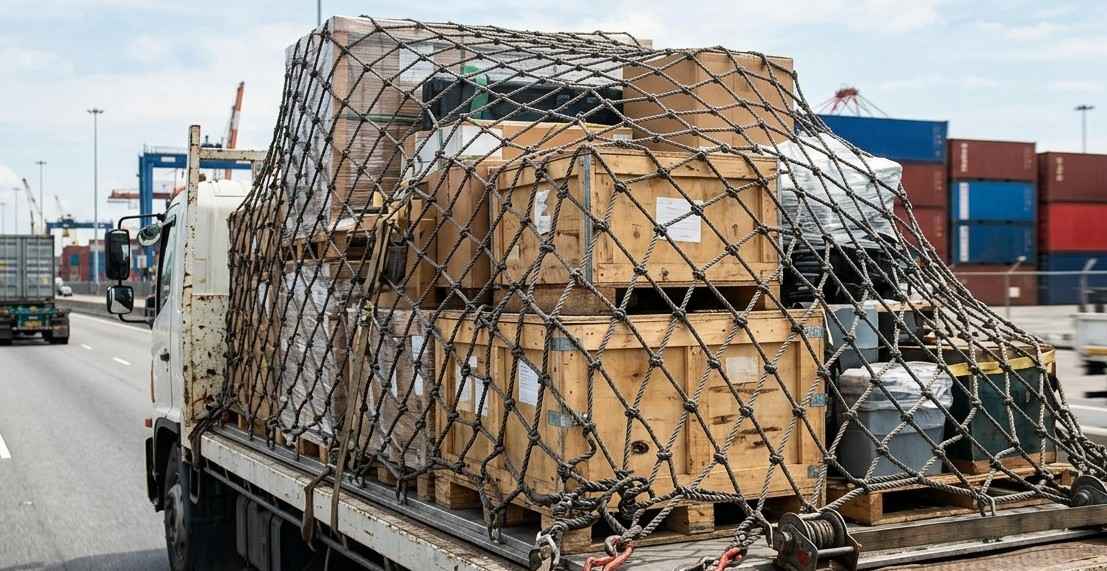
Cargo Net: Types, Uses & Benefits | Complete Guide
A cargo net is a flexible solution used to secure, lift, contain, and transport different types of materials. Unlike rigid containers or individual straps, cargo nets can adapt to irregular shapes and cover larger areas, making them useful for bulky, loose, and grouped loads.
They are commonly used in construction, transportation, logistics, warehouses, marine operations, and industrial material handling. Understanding the types of cargo nets, their uses, benefits, and selection factors can help you choose the right net for your application.
What Is a Cargo Net?
A cargo net is a mesh structure made from interconnected ropes, webbing, or synthetic fibers. It secures loads by creating multiple contact and attachment points, helping distribute forces across the cargo.
Depending on its design, a cargo net may be placed over materials during transportation, positioned underneath loads for lifting, or used to contain loose items.
Cargo nets are available in different materials, dimensions, mesh sizes, and load capacities. The right choice depends on the cargo weight, shape, handling method, and working environment.
How Does a Cargo Net Work?
A cargo net works by holding a load across multiple points rather than relying on a single strap or attachment. When tension is applied, the mesh helps distribute the securing force across a wider area.
For transportation, the net is generally placed over the cargo and connected to suitable anchor points. Specialized lifting nets can support materials underneath or around the sides during crane or hoist operations.
This makes cargo nets particularly useful for irregular loads, loose materials, bulky cargo, and grouped items.
Types of Cargo Nets
1. Cargo Restraint Nets
Cargo restraint nets are designed to prevent materials from shifting during transportation. They are commonly used on trucks, trailers, flatbeds, and open transport platforms.
They can secure construction materials, equipment, boxes, and other loose goods.
2. Cargo Lifting Nets
Cargo lifting nets are designed for lifting materials using cranes, hoists, and other equipment. Their flexible structure allows them to support loads with unusual shapes.
The net’s working load limit (WLL) must always be suitable for the load and lifting configuration.
3. Rope Cargo Nets
Rope cargo nets are made from interconnected high-strength ropes. Their flexibility allows them to conform to different load shapes.
They are commonly used in construction, transportation, marine, and industrial applications.
4. Webbing Cargo Nets
Webbing cargo nets use flat synthetic webbing instead of rope. Their wider surface provides greater contact with the load and can be useful where broad load coverage is required.
They are commonly used for transportation and industrial load restraint.
5. Safety Nets
Safety nets are designed to help prevent people, tools, or materials from falling. Although they can look similar to cargo nets, they are designed for different safety applications.
They should be selected according to the specific purpose and applicable requirements.
Common Uses of Cargo Nets
Cargo nets are used across several industries because of their flexibility and ability to accommodate different loads.
Transportation and Logistics
Cargo nets help secure goods on trucks, trailers, and open platforms. They are particularly useful for loose or irregular materials that may shift during transportation.
Construction
Construction sites often handle pipes, timber, tools, equipment, and other materials with different dimensions. Cargo nets can help secure these materials during transportation and handling.
For lifting applications, the net must be specifically rated for the intended load.
Warehouses
In warehouses, cargo nets can help contain or move groups of loose and irregular items. They can be used during material-handling operations when the net is compatible with the equipment and load.
Marine and Offshore Operations
Cargo nets are useful for moving equipment, supplies, and other materials in marine and offshore environments. When used in these conditions, resistance to moisture, salt, sunlight, and abrasion should be considered.
Aviation and Helicopter Operations
Specialized cargo nets can be used for certain aviation and helicopter material-handling applications. These operations require properly rated equipment designed for the specific lifting conditions.
Benefits of Cargo Nets
Flexible Design
Cargo nets can accommodate different shapes and sizes, making them suitable for irregular and grouped loads.
Load Distribution
Multiple contact points help distribute securing forces across a wider area when the net is correctly selected and installed.
Easy Handling
Many synthetic cargo nets are lightweight, flexible, and easy to fold and store.
Better Load Stability
A properly installed net can help reduce unwanted movement of materials during transportation and handling.
Reusable
Quality cargo nets can be reused when regularly inspected, maintained, and stored correctly.
Cargo Net vs Cargo Strap
Cargo nets and straps are both used for load securing, but they work best in different situations.
| Feature | Cargo Net | Cargo Strap |
|---|---|---|
| Coverage | Larger area | Specific areas |
| Load Shape | Irregular or grouped | Defined loads |
| Flexibility | High | High |
| Load Distribution | Multiple points | Strap paths |
| Typical Use | Loose and bulky cargo | Individual loads |
In some applications, cargo nets and straps can also be used together.
How to Choose the Right Cargo Net
Choosing the correct cargo net involves considering several important factors.
Check the Working Load Limit
For lifting applications, always check the WLL and ensure it is suitable for the load and lifting configuration. Never rely on appearance or size alone.
Consider the Cargo
Look at the load’s weight, dimensions, shape, and surface. Sharp edges and abrasive materials may require additional protection or a specialized net.
Select the Right Material
Polyester and nylon are common cargo net materials. The correct option depends on exposure to sunlight, moisture, chemicals, abrasion, and temperature.
Choose the Correct Mesh Size
Mesh size should match the cargo. Smaller openings can help contain smaller loose items, while larger mesh may be suitable for bulky materials.
Inspect Before Use
Check for cuts, broken strands, damaged stitching, excessive abrasion, chemical damage, and damaged attachment points before use.
Damaged nets should be removed from service and assessed according to the relevant safety procedures.
Conclusion
Cargo nets offer a practical way to secure, lift, and transport bulky, loose, or irregular loads across construction, logistics, marine, and industrial applications. Selecting the right net requires careful consideration of factors such as load capacity, material, mesh size, and the intended method of use.
For related marine and industrial requirements, K. Hashim LLC supports marine & industrial supply in UAE along with solutions for various material-handling needs. Choosing equipment based on the load and working environment can help ensure safer and more reliable handling.
For product details or application-specific requirements, contact our team for further information.
Explore More Expert Insights
Explore our expert insights to stay updated on the latest piping solutions, flange types, and industrial best practices.
- Unlocking Potential of Stainless Steel Grease Nipples in UAE Industries: Corrosion resistant solutions for heavy industrial performance.
- Top Applications for Stainless Steel Grease Nipples in Heavy Machinery: Real world industrial use cases improving lubrication efficiency.
- Why Stainless Steel Grease Nipples Are Essential for Corrosion-Prone Environments: Protection driven lubrication for harsh operating conditions.
- What is Wool Felt Sheet? Types, Properties and Uses: Wool felt sheet explained with types, properties, and industrial uses.
- Key Points for Maintenance and Upkeep of Marine Valves: Essential tips to keep your marine valves performing reliably.
Popular Posts

April 4, 2024

April 22, 2024


May 28, 2024