
- Abrasives & Drilling
- Buttweld Fittings
- Camlock Couplings and Fittings
- Clamps & Couplings
- Deck & Engine Store Supplies
- Fasteners & Hardware
- Fittings & Flanges
- Gaskets
- High-Pressure Pipe Fittings
- Hoses
- Industrial Epoxies & Spray Coatings
- Industrial Fasteners – Bolts, Nuts & Screws
- Industrial Gaskets & Sealing Products
- Lifting & Rigging
- Marine
- Marine Valves & Flow Control Solutions
- Oilfield & Industrial Supplies
- Packing & Industrial Materials
- Pipe Couplings & Expansion Joints
- PPE & Chemicals
- Safety
- Safety Items & Personal Protective Equipment
- Steel Flanges for Piping Systems
- Tools
- Valves
- Industrial Area 1, Sharjah, UAE
- sales@khashim.com
- info@khashim.com
- +971 6 533 8006
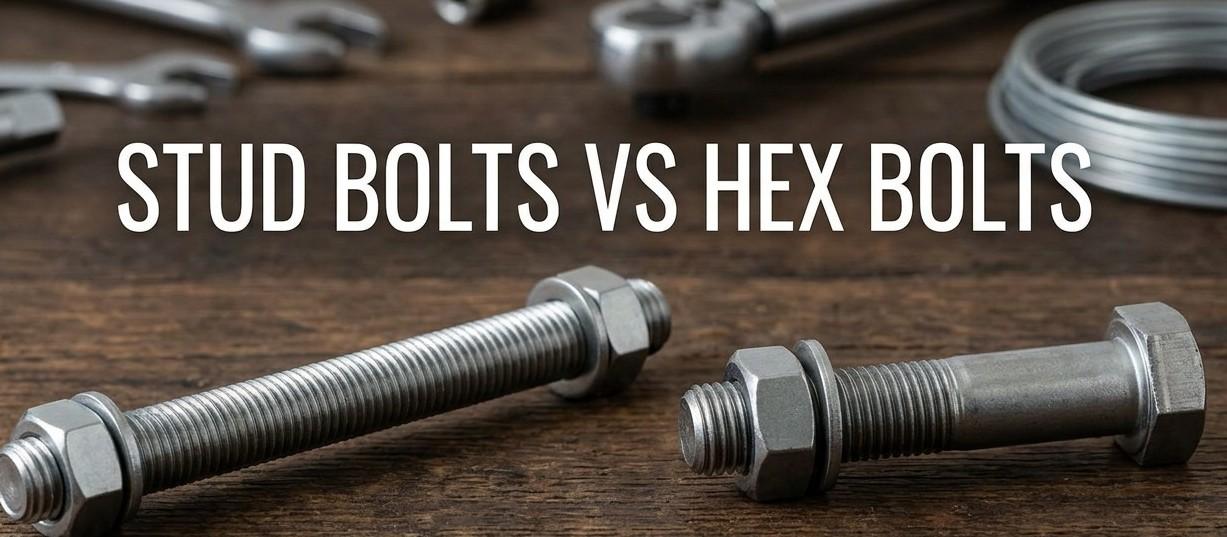
Stud Bolts vs Hex Bolts: Which Fastener Is Right for Your Application?
When engineers and procurement specialists sit down to plan a project, fastener selection is one of the first real decisions on the table. Choosing between stud bolts and hex bolts carries direct consequences for joint integrity, sealing performance, and long-term maintenance costs. Both fasteners hold assemblies together but they do it in fundamentally different ways, and the wrong choice can result in leaks, loosening, and unplanned downtime that no project budget accounts for.
What makes this decision worth getting right is that these two fasteners are not interchangeable alternatives. They are purpose-built for different conditions, different loads, and different service environments.
Understanding what separates them at a mechanical level and knowing where each one performs at its best is what allows engineers, contractors, and procurement teams to make a specification they can stand behind.
What Are Stud Bolts?
Stud bolts are headless, fully or partially threaded rods that secure joints using nuts on both ends. Both ends thread into the assembly and the clamping force is distributed evenly across both nuts. This headless design makes them well suited for tight or confined spaces where a bolt head would obstruct access or create an uneven bearing surface.
Industries like oil and gas, petrochemicals, and power generation rely on stud bolts almost exclusively for flanged pipeline connections and pressure vessels where leakage cannot be tolerated.
Common types of stud bolts
- Fully threaded studs with threads running the entire length for maximum grip
- Double-end studs with threads at both ends and a plain shank in the middle
- Tap-end studs with different thread lengths at each end for use with tapped holes
What Are Hex Bolts?
Hex bolts are one-piece fasteners with a six-sided head and a threaded shank, tightened using a wrench or socket applied directly to the head. This makes installation fast and practical in applications where access is limited to one side of the assembly. Their availability across multiple grades, sizes, and materials makes them the standard choice for construction frames, machinery housings, automotive assemblies, and equipment brackets.
Common types of hex bolts
- Standard hex bolts with partial thread and plain shank for clearance hole applications
- Fully threaded hex bolts with threads along the full shank for shorter grip applications
- Flange hex bolts with an integrated flange under the head for wider load distribution
Key Differences Between Stud Bolts and Hex Bolts
The differences between these two fasteners go deeper than appearance. Understanding the mechanical behavior of each one helps engineers match the right fastener to the right service condition.
| Feature | Stud Bolts | Hex Bolts |
|---|---|---|
| Head Design | No head, nuts on both ends | Hexagonal head, one nut |
| Torque Application | Applied to nuts, not the stud body | Applied directly to the bolt head |
| Load Distribution | Even across both ends | Concentrated at the head end |
| Access Requirement | Both sides of the joint needed | Single-sided access is sufficient |
| Typical Pressure Rating | Up to PN40 and above | Typically up to PN16 |
| Best Environment | High pressure, high temperature | General structural and mechanical |
| Maintenance | Nuts can be split without damaging the stud | Head can round off or seize in tapped holes |
Installation Method and Access Requirements
Hex bolts only need access from one side of the joint, which makes them convenient for blind-hole applications and tight assemblies where reaching behind the component is not possible. A single wrench or socket drives them in and secures the connection without any additional hardware on the reverse side.
Stud bolts require clear access to both sides of the joint because a nut must be fitted and tightened on each end. This is not a limitation in most flange applications since through-access is standard, but it does rule stud bolts out for blind-hole situations where one side is inaccessible.
Load Distribution and Clamping Force Accuracy
When torque is applied to the head of a hex bolt, a meaningful portion of that energy is absorbed by friction between the head bearing surface and the mating component and between the thread flanks. The bolt body also experiences torsional stress as it rotates and this twisting does not contribute to clamping force, making precise and repeatable preload harder to achieve.
Stud bolts handle this differently. Torque goes only to the nut, the stud body goes into pure tension, and the clamping force is far more accurate and uniform. For gasketed joints where even a small difference in compression across the sealing face can cause a leak, this distinction is critical to reliable performance.
Performance in High Pressure and High Temperature Service
For pipelines, pressure vessels, heat exchangers, and reactors, stud bolts are not just preferred — they are specified by code. Standards like ASME B16.5 mandate stud bolts for flanged connections in critical service because their pure-tension loading method ensures the gasket is compressed uniformly across the entire sealing face.
Even when the system goes through thermal cycling with expansion and contraction from temperature changes, a properly preloaded stud bolt maintains joint integrity in a way that a hex bolt typically cannot. Hex bolts perform reliably in moderate-stress structural applications but the stress concentration at the head-shank junction becomes a liability under sustained high loads or dynamic vibration.
Explore a complete range of industrial stud bolts and hex bolts in materials and grades suited for both standard and critical service conditions.
Material Options and Corrosion Resistance
Both fastener types are available in carbon steel, alloy steel, and stainless steel, but the material specifications most commonly associated with each reflect their typical service environments. Stud bolts in high-temperature piping are most often manufactured to ASTM A193 Grade B7, a chromium-molybdenum alloy that retains strength at temperatures up to around 482°C and is typically paired with ASTM A194 Grade 2H heavy hex nuts.
For higher temperatures approaching 593°C, Grade B16 is used. Hex bolts in structural applications commonly follow ASTM A325 or A307 grades, while stainless steel grades are available across both types for environments involving moisture, chemicals, or marine exposure.
Maintenance, Replacement, and Long-Term Cost
If a hex bolt seizes in a tapped hole due to corrosion or over-torquing, the head can round off and extracting it often means drilling out the fastener and re-tapping the hole, which is a costly and time-consuming repair. The issue is compounded in critical systems where downtime carries financial and safety implications.
With stud bolts, the exposed nuts absorb wear and corrosion first. A seized or damaged nut can be split and removed without touching the stud itself, and the stud can often be reused or replaced without disturbing the flange or surrounding components. In systems that undergo regular inspection and maintenance cycles, this serviceability advantage adds up considerably over time.
Choosing the Right Fastener for Your Project
If the connection involves a gasketed flange, operates under elevated pressure or temperature, or sits inside a system where leakage would be dangerous or costly, stud bolts are the right choice. If the connection is structural, mechanical, or general-purpose and operating conditions are stable, hex bolts offer practical and cost-effective performance.
Budget plays a role as well. Hex bolts are widely available and easy to source in bulk at competitive prices, while stud bolts carry a higher unit cost that is easily justified by their service life and reliability in demanding environments. Getting the selection right at the specification stage avoids costly corrections later in the project lifecycle.
Conclusion
Stud bolts and hex bolts each have a clear role in industrial and structural applications. Stud bolts deliver the precise clamping force, sealing integrity, and maintenance flexibility that high-pressure and high-temperature systems demand. Hex bolts bring versatility, ease of installation, and broad availability to the full range of general-purpose fastening needs. Selecting the right one from the start protects the integrity of the connection and reduces the risk of failures down the line.
Hashim LLC supplies high quality bolts and fastening components designed to meet the demands of industrial operations across the UAE, from standard structural assemblies to critical high-pressure pipeline systems.
Partner with our fastener specialists for dependable bolt solutions tailored to your project specifications and operating requirements.
Explore More Expert Insights
Explore our expert insights to stay updated on the latest piping solutions, flange types, and industrial best practices.
- Unlocking Potential of Stainless Steel Grease Nipples in UAE Industries: Corrosion resistant solutions for heavy industrial performance.
- Top Applications for Stainless Steel Grease Nipples in Heavy Machinery: Real world industrial use cases improving lubrication efficiency.
- Why Stainless Steel Grease Nipples Are Essential for Corrosion-Prone Environments: Protection driven lubrication for harsh operating conditions.
- What is Wool Felt Sheet? Types, Properties and Uses: Wool felt sheet explained with types, properties, and industrial uses.
- Key Points for Maintenance and Upkeep of Marine Valves: Essential tips to keep your marine valves performing reliably.
Popular Posts

April 4, 2024

April 22, 2024


May 28, 2024