
- Buttweld Fittings
- Camlock Couplings and Fittings
- Clamps & Couplings
- Deck & Engine Store Supplies
- Fittings & Flanges
- High-Pressure Pipe Fittings
- Hoses
- Industrial Epoxies & Spray Coatings
- Industrial Fasteners – Bolts, Nuts & Screws
- Industrial Gaskets & Sealing Products
- Lifting & Rigging
- Marine Valves & Flow Control Solutions
- Oilfield, Marine & Industrial Supplies
- Pipe Couplings & Expansion Joints
- Safety Items & Personal Protective Equipment
- Steel Flanges for Piping Systems
- Tools, Abrasives & Drilling
- Industrial Area 1, Sharjah, UAE
- sales@khashim.com
- info@khashim.com
- +971 6 533 8006
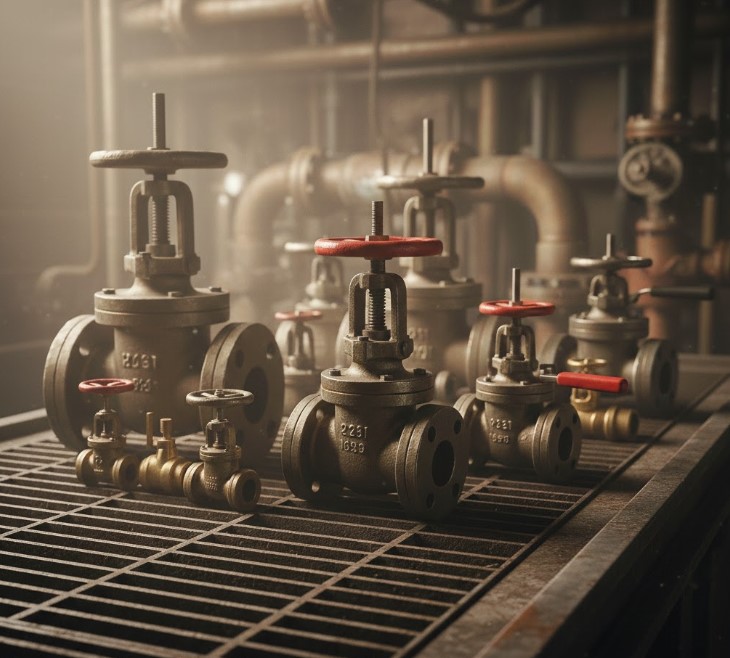
Marine Valves Explained: Types, Uses & Applications
Marine valves are critical components in maritime engineering, ensuring the safe and efficient operation of ships and offshore installations. From regulating fuel flow in engines to managing ballast water for stability, marine valves are indispensable in all shipboard systems.
Understanding their types, functions, and applications is essential for marine engineers, ship operators, and industrial maintenance professionals.
In this guide, we’ll explore the main marine valve types, their applications, maintenance considerations, and industry standards, providing a comprehensive resource for professionals in the maritime sector.
What Are Marine Valves?
Marine valves also called ship valves, are mechanical devices that control the flow of liquids and gases in maritime piping systems. These valves maintain operational integrity of systems such as cooling circuits, ballast water lines, fuel transfer systems, and firefighting networks.
In high-stress marine environments, corrosion resistance, pressure tolerance, and reliable actuation are non-negotiable features. Operators must ensure that every valve complies with classification society standards and can withstand wide temperature swings, saline exposure, and cyclic loads.
Core Functions of Marine Valves
Valves perform several foundational functions in marine systems:
- Isolation Control to stop flow while equipment is serviced.
- Throttling and Regulation to fine-tune flow rates.
- Backflow Prevention to prohibit reverse flow that could damage critical equipment.
- Pressure Relief Management to safeguard against overpressure conditions that pose safety risks.
Each valve type has a specific role and must be selected with knowledge of fluid characteristics, system pressure, and expected operating conditions.
Main Types of Marine Valves
Marine valves are designed for specific functions and fluid types, from water and fuel to gases. Here are the most commonly used types:
1. Ball Valves
Ball valves use a rotating spherical ball with a hole through its center to control flow. Turning the handle rotates the ball, aligning the hole with the pipe for flow or perpendicular to stop it.
Ball valves are one of the most widely used valve types in marine applications. Selecting the correct marine ball valve involves ensuring material compatibility and actuator reliability to withstand saltwater exposure and vibration.
Key benefits:
— Quick operation (quarter-turn)
— Durable and leak-resistant
— Suitable for fuel, water, and gas systems
Applications: Fuel lines, engine cooling, and onboard water systems
2. Gate Valves
Gate valves feature a sliding gate that moves vertically to start or stop fluid flow. They are ideal for applications where full flow or complete shutoff is required and are not recommended for throttling.
Advantages:
— Minimal pressure drop when fully open
— Reliable sealing for liquids and gases
— Long service life
Applications: Ballast water systems, main engine cooling circuits, cargo fluid control
3. Globe Valves
Globe valves regulate flow with a movable plug or disc against a stationary seat. They provide precise flow control but are less suitable for full-flow systems due to higher pressure drops. Because of their design, they offer better throttling characteristics than gate valves, though they may present higher pressure drop.
For marine engineers, specifying the correct globe valve means balancing control precision with acceptable head loss.
Advantages:
— Accurate throttling capability
— Resistant to vibration in piping systems
— Robust design for high-pressure applications
Applications: Lubrication systems, steam lines, fuel injection control
4. Butterfly Valves
Butterfly valves use a rotating disc to control flow. These valves are lightweight and compact, making them suitable for large pipeline systems where space is limited and fast actuation is required. Their design allows for quick response but requires careful sizing to avoid cavitation and ensure sealing integrity.
Advantages:
— Quick quarter-turn operation
— Cost-effective for large pipelines
— Low maintenance requirements
Applications: Ballast water management, HVAC systems, cooling water lines
5. Check Valves
Check valves allow fluid to flow in one direction only, preventing backflow that could damage pumps or engines. These valves automatically close when flow reverses, protecting pumps, compressors, and other sensitive equipment. Common types of check valves used in marine settings include swing check and lift check designs.
Applications: Engine cooling, bilge pumps, fuel transfer systems
Marine Valve Applications Onboard
Marine valves are used across multiple ship systems. Understanding their applications ensures proper valve selection and operational safety.
| System | Valve Type | Purpose |
|---|---|---|
| Engine Cooling | Ball, Globe | Control coolant flow, prevent overheating |
| Fuel Transfer | Ball, Globe | Regulate fuel delivery to engines |
| Ballast Systems | Gate, Butterfly | Adjust ship stability by controlling water intake |
| Gas Lines | Ball, Globe, Check | Manage compressed gases safely |
| Bilge and Sewage | Check, Gate | Prevent backflow and control drainage |
Maintenance and Safety Tips for Marine Valves
Proper maintenance is crucial to prevent leaks, corrosion, and mechanical failure. Key practices include:
- Regular Inspection – Check for leaks, wear, and valve integrity
- Lubrication – Ensure smooth operation of moving parts
- Pressure Testing – Validate that valves meet operational standards
- Corrosion Protection – Apply coatings or select corrosion-resistant materials for seawater exposure
- Documentation – Maintain maintenance logs to comply with maritime regulations
Material Selection and Corrosion Resistance
Marine valves must withstand harsh maritime conditions, including saltwater, high pressures, and temperature fluctuations. Common materials include:
— Bronze and Brass: Excellent corrosion resistance, ideal for freshwater and seawater systems
— Stainless Steel: High strength, suitable for high-pressure systems and chemical resistance
— Cast Iron: Economical choice for low-pressure applications
Selecting the right material increases valve longevity and reduces operational risks.
Industry Standards for Marine Valves
Compliance with standards ensures safety, reliability, and certification for marine operations:
— ABS (American Bureau of Shipping) – Certification for shipboard equipment
— DNV (Det Norske Veritas) – Quality and safety standards
— ISO 9001 / ISO 14001 – Quality management and environmental compliance
Meeting these standards is crucial for ship operators, manufacturers, and maintenance teams.
FAQs
What is the primary purpose of marine valves?
Marine valves control the flow of liquids and gases, isolate system sections, and maintain pressure stability. They are essential for safe and efficient shipboard operations.
How often should marine valves be maintained?
Valves should be inspected regularly, with monthly visual checks and quarterly detailed maintenance to prevent leaks and mechanical issues.
Which valve type is best for precise flow control?
Globe valves are ideal for regulating flow because their design allows gradual adjustments in engine cooling and auxiliary circuits.
What materials are best for marine valve construction?
Marine-grade stainless steel, bronze, and duplex alloys resist corrosion and wear, ensuring long-term reliability in harsh saltwater environments.
Conclusion
Marine valves play a crucial role in maintaining the safety, efficiency, and reliability of shipboard systems. From ball and gate valves to globe and butterfly valves, each type serves a specific purpose in controlling fluids, gases, and ballast water onboard.
Proper selection, material consideration, and regular maintenance ensure long-term performance, reduce operational risks, and prevent costly downtime. Sourcing from a trusted supplier guarantees quality and reliability, and K. Hashim LLC is a leading marine valve supplier in UAE, offering top-grade valves for industrial, marine, and offshore applications.
Connect with our technical specialists today to secure the right valves for enhanced ship safety and long‑term operational efficiency.
Discover Guides on Marine Hardware and Repair Solutions
— The Role of Eye Bolts and Nuts in Marine and Outdoor Environments: Essential hardware for securing loads in marine and outdoor settings.
— Why Stainless Steel Studs Are Ideal for Marine Applications: Durable fasteners designed to resist corrosion in harsh maritime conditions.
— The Role of K.Hashim LLC Copper and Washer Kit in Marine Engine Repairs: Reliable components ensuring leak-free and efficient engine maintenance.
— How Devcon Marine Epoxies in UAE Extend Ship Lifespan: Innovative marine adhesives that protect vessels from wear and corrosion.
— Top Reasons to Choose Devcon Marine Epoxies UAE: Proven performance solutions for long-lasting marine repairs.
Popular Posts

April 4, 2024

April 22, 2024


May 28, 2024
Stores index
- 01Marine valves19 products
- 02Fittings & flanges10 products
- 03Gaskets & sealing20 products
- 04Fasteners20 products
- 05High-pressure fittings13 products
- 06Epoxies & coatings30 products
- 07Deck & engine store20 products
- 08Safety & PPE12 products
- 09Lifting & rigging7 products
- 10Hoses6 products
- 11Clamps & couplings6 products
- 12Tools & abrasives4 products
- 13Buttweld fittings9 products
- 14Steel flanges8 products
- 15Camlock couplings4 products
- 16Oilfield supplies4 products
- 17Couplings & expansion joints2 products
How an order works
- Send your listItem, size, grade, quantity and delivery location.
- We check stockAvailability is confirmed from our Sharjah warehouse.
- You receive a quotationPriced for your approval, with the delivery terms.
- DeliveryFree on orders of AED 3,000 and above.