
- Abrasives & Drilling
- Buttweld Fittings
- Camlock Couplings and Fittings
- Clamps & Couplings
- Deck & Engine Store Supplies
- Fasteners & Hardware
- Fittings & Flanges
- Gaskets
- High-Pressure Pipe Fittings
- Hoses
- Industrial Epoxies & Spray Coatings
- Industrial Fasteners – Bolts, Nuts & Screws
- Industrial Gaskets & Sealing Products
- Lifting & Rigging
- Marine
- Marine Valves & Flow Control Solutions
- Oilfield & Industrial Supplies
- Packing & Industrial Materials
- Pipe Couplings & Expansion Joints
- PPE & Chemicals
- Safety
- Safety Items & Personal Protective Equipment
- Steel Flanges for Piping Systems
- Tools
- Valves
- Industrial Area 1, Sharjah, UAE
- sales@khashim.com
- info@khashim.com
- +971 6 533 8006
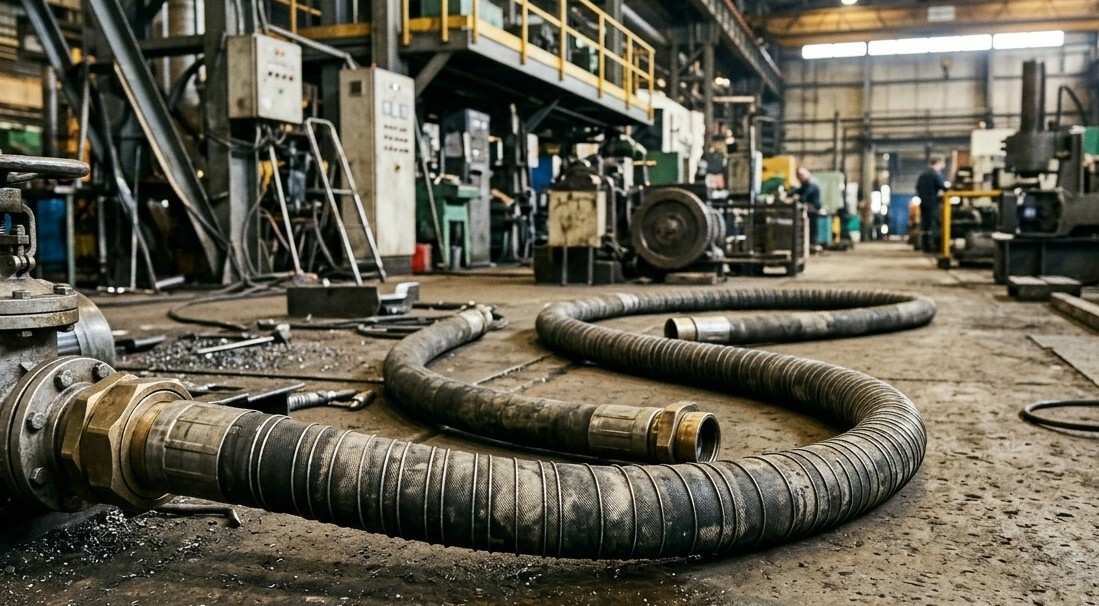
What Is An Industrial Hose Everything You Need To Know
Industrial hoses are used across manufacturing plants, construction sites, and processing facilities to move liquids, gases, and even dry materials from one point to another. Choosing the correct hose affects safety, efficiency, and long term equipment performance.
This guide explains what an industrial hose is, how it is built, the common types available, and the key factors to consider before selecting one for your application.
What Is An Industrial Hose?
An industrial hose is a flexible tube engineered to transfer liquids, gases, powders, and other materials in demanding work environments. Unlike rigid tubing, an industrial hose can bend and flex while still handling pressure, temperature changes, and chemical exposure.
These hoses are built to resist abrasion, corrosion, and continuous wear, which makes them suitable for plants, refineries, and outdoor job sites where conditions are harsh and downtime is costly.
How Industrial Hoses Are Made?
Every industrial hose is built using three core layers. Each layer plays a specific role in how the hose performs under real world conditions.
Inner Tube
The inner tube is the innermost layer that comes into direct contact with the material being transferred. It must resist the chemical properties of that material, whether it is fuel, water, food product, or a harsh chemical.
Reinforcement Layer
This layer sits between the inner tube and the outer cover. It is braided, spiraled, or knitted using textile fibers or steel wire and gives the hose its strength and pressure rating.
Outer Cover
The outer cover protects the hose from sunlight, weather, abrasion, and mechanical damage. It is usually made from rubber, PVC, or a thermoplastic compound depending on where the hose will be used.
| Layer | Main Function | Common Materials |
|---|---|---|
| Inner Tube | Carries the fluid or material safely | Nitrile, EPDM, Butyl Rubber |
| Reinforcement | Adds strength and pressure resistance | Steel Wire, Polyester, Nylon |
| Outer Cover | Protects against weather and abrasion | Rubber, PVC, Thermoplastic |
Common Types Of Industrial Hoses
Different industries rely on different hose types depending on the material being moved and the environment the hose will operate in.
- Air pressure hoses used for pneumatic tools and compressed air systems
- Chemical hoses used for transferring corrosive or hazardous substances
- Food and beverage hoses built to meet sanitary and FDA related standards
- LPG hoses designed for petroleum gas transfer with added safety features
- Bulk material hoses used to move sand, grain, cement, and similar substances
- Steam hoses rated for high heat and pressure applications
Fittings and connectors also play a major role in how a hose performs once installed. You can browse our full range of industrial hoses to compare options built for these applications.
How To Choose The Right Industrial Hose?
Selecting the correct hose comes down to matching its specifications to your application. Industry professionals often use the STAMPED method to guide this process.
- Size, including inner and outer diameter
- Temperature range the hose must withstand
- Application and the environment it will operate in
- Material or medium being transferred
- Pressure rating required for safe operation
- Ends, meaning the fittings and connection type
- Delivery timeline needed for your project
Getting these factors right helps prevent leaks, premature wear, and unplanned downtime. Our team can help you match these criteria against our hose product range to find the right fit for your application.
Industrial Hose Versus Industrial Tubing
Industrial hoses and industrial tubing are often confused, yet they serve different purposes.
| Feature | Industrial Hose | Industrial Tubing |
|---|---|---|
| Flexibility | Highly flexible | Rigid or semi-rigid |
| Reinforcement | Braided or spiral wound | Usually unreinforced |
| Pressure Rating | Medium to high | Low to medium |
| Common Use | Fluid transfer and material handling | Instrumentation and control lines |
Hoses are chosen when flexibility and pressure handling are required, while tubing suits fixed, low pressure systems.
Maintenance And Safety Tips For Industrial Hoses
Routine inspection extends hose life and keeps workers safe. Check hoses regularly for the following signs of wear.
- Cracks, blisters, or soft spots on the outer cover
- Visible abrasion or exposed reinforcement layers
- Loose, corroded, or leaking fittings
- Kinks or flattening along the hose length
Replacing a worn hose before it fails is far less costly than dealing with unplanned downtime or a safety incident on site. A regular inspection schedule keeps operations running smoothly and protects your team.
Conclusion
Industrial hoses are a core part of safe and efficient material handling across manufacturing, construction, oil and gas, and food processing industries. Understanding hose construction, types, and selection criteria helps you choose a hose that performs reliably for your specific application.
Get Expert Support For Industrial Hose And Safety Solutions
Reliable equipment is essential for maintaining safe and efficient operations across demanding industries. K. Hashim LLC supplies high quality industrial hoses and safety solutions designed to support operational reliability and workplace safety.
Partner with our experts for hose and safety solutions tailored to your workplace requirements.
Explore More Expert Insights
Discover guides on all hardware, building materials, and electrical products for your next project.
- Pilot Ladder and Manila Rope Guide for Safe Boarding: Guidance on pilot ladders and manila rope for safe vessel boarding.
- Different Types of Electrical Accessories and Their Uses: Overview of common electrical accessories and their uses.
- What Are Welding Gauges? Types, Uses, and How They Work: Basics of welding gauges and their inspection role.
- What Is a Mitutoyo Digital Caliper? Types, Uses & Accuracy: Guide to Mitutoyo digital calipers and accuracy.
- Top Guide to Mitutoyo Bore Gages for Internal Diameter Measurement: Understanding bore gages for internal measurements.
Popular Posts

April 4, 2024

April 22, 2024


May 28, 2024